Table of contents
- What changes under pressure
- The hidden decision problem
- What to notice first
- A practical way to train it
- Common mistakes
- The quick decision framework
- Examples you can use right away
- A coachable way to think about it
- A seven-day practice plan
- Common mistakes and better fixes
- Reader checklist
- How this shows up before the obvious mistake
- A simple review loop
- What this is not saying
Direct answer: What separates good fighters from smart fighters is clearer when treated as a decision-making problem: what pressure is present, what structure is failing, and what next training choice gives the fighter a clearer map.

What separates good fighters from smart fighters is a practical question because pressure changes the mind before it changes the scoreboard.
When attention narrows, a fighter can still look active while losing access to the options that would actually solve the exchange.
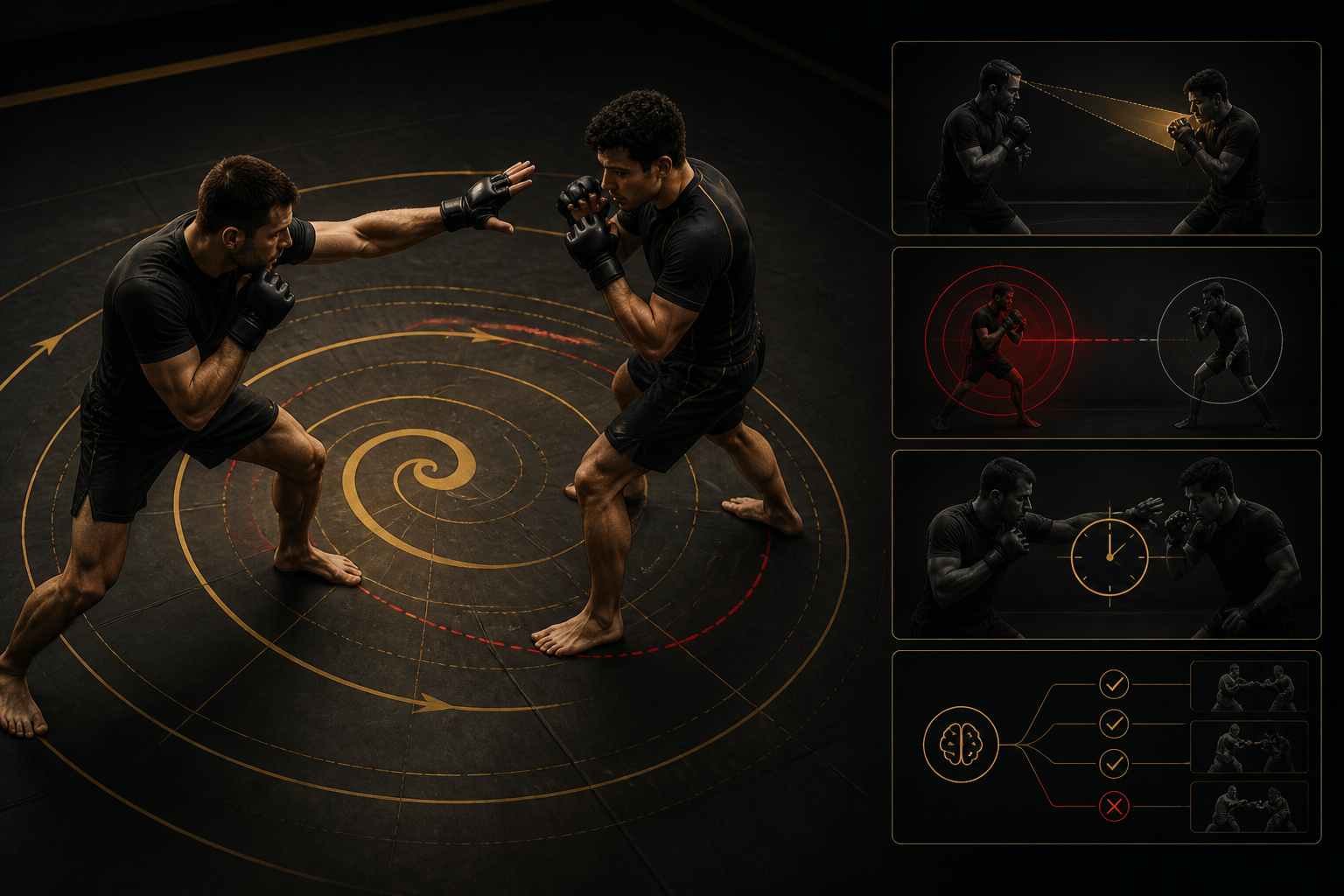
What changes under pressure
Pressure changes what a person notices first. It narrows attention, speeds up internal narration, and makes familiar options feel farther away than they really are.
What separates good fighters from smart fighters matters because the visible mistake is usually only the end of the chain. The earlier mistake is often a change in attention, breath, posture, or perceived time.
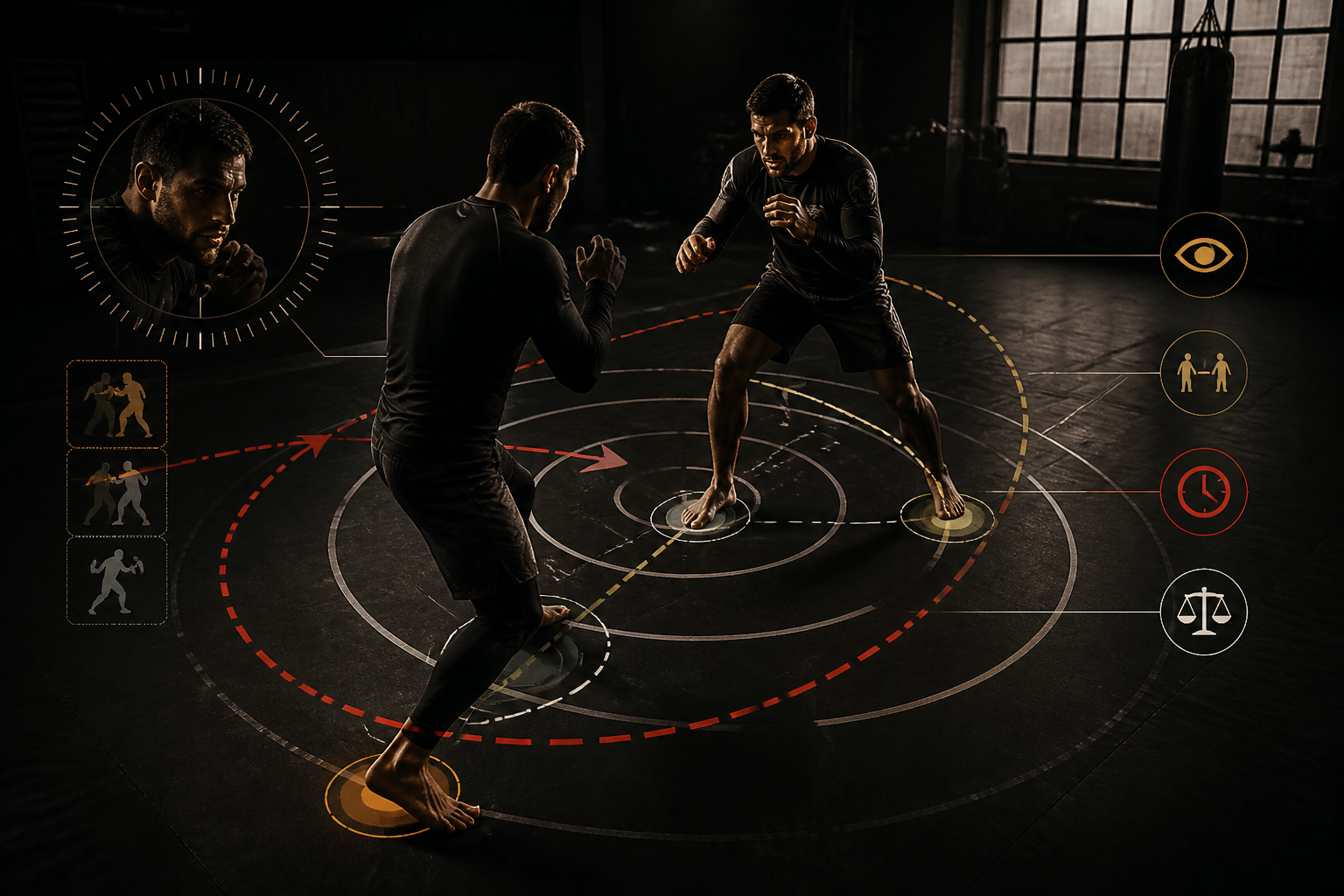
The hidden decision problem
A fighter rarely says, I am choosing badly now. The experience feels more automatic than that. They chase, shell up, overcommit, or wait too long because the pressure has already changed the decision environment.
That is why better fight IQ is not just more knowledge. It is the ability to keep enough perception online to choose from the right menu.
What to notice first
Start by watching the first sign of collapse: rushed breathing, square feet, late exits, eyes locked on one target, or a sudden need to force the exchange.
Once the first sign is visible, the correction becomes smaller. You are no longer trying to fix the whole round. You are trying to recover one readable state.
A practical way to train it
Use one cue, one reset, and one review question. The cue tells you pressure is rising. The reset gives you a physical action to regain structure. The review question keeps the lesson honest afterward.
For example: notice when your eyes stop scanning, reset with a small exit or breath, then ask what option disappeared first.
Common mistakes
The common mistake is treating composure as personality. In training, composure is often a skill built from repeatable signals, recoverable positions, and honest review.
Another mistake is trying to add complexity when the athlete needs a cleaner first read.
The quick decision framework
Use this framework when what separates good fighters from smart fighters starts to feel abstract. The point is to turn the idea into a practical read: what changed, what options disappeared, and what should happen next.
A strong Spiral Combat article should give the reader a tool they can reuse. This table is the simplest version of that tool.
| Layer | What to check | Useful question |
|---|---|---|
| Pressure signal | The first visible change before the mistake | What changed before the obvious exchange? |
| Structure | Feet, posture, frames, exits, and usable space | Did the athlete gain options or lose them? |
| Attention | Where the eyes and mind are locked | What did pressure make the person stop seeing? |
| Timing | The beat where initiative changes hands | Was the action early, late, or forced? |
| Reset | The smallest reliable way back to clarity | What reset would make the next rep cleaner? |
Examples you can use right away
Examples matter because a reader should not have to guess how the idea appears in real training, coaching, or fight study.
Use these as starting points, then replace them with your own clips, rounds, or member questions.
| Situation | What it usually means | Cleaner next move |
|---|---|---|
| The athlete chases after missing | Status panic is replacing the original plan | Reset the feet, breathe, and re-enter from structure. |
| The athlete shells up too early | Pressure narrowed attention to survival only | Name one exit or frame before adding offense. |
| The athlete keeps saying they felt rushed | Perceived time collapsed before technique failed | Slow the drill and identify the first timing cue. |
A coachable way to think about it
A good article should not only explain the concept. It should give the reader one sentence they can carry into the next round, class, or film session.
The useful question is not, "Do I understand this idea?" The useful question is, "What will this help me notice sooner?"
A seven-day practice plan
The idea becomes easier to use when it gives the reader a small implementation path. This plan keeps the work simple enough to actually do.
| When | Action |
|---|---|
| Day 1 | Watch one round or training clip and write the first pressure signal you notice. |
| Day 2 | Choose one cue that appears before the mistake, not after it. |
| Day 3 | Pick one simple reset that can be used while the round is still live. |
| Day 4 | Test the cue and reset in a controlled drill or slow review. |
| Day 5 | Compare two moments: one where options expanded and one where they narrowed. |
| Day 6 | Write the cleanest coaching sentence or self-review note from the pattern. |
| Day 7 | Decide whether this topic deserves a deeper lesson, video, or product path. |
Common mistakes and better fixes
Most people do not fail because they lack effort. They fail because the idea stays too broad, too late, or too disconnected from the next rep.
| Mistake | Better fix |
|---|---|
| Trying to fix everything at once | Choose one cue, one reset, and one review question for the next session. |
| Mistaking intensity for clarity | Ask whether the extra effort actually created better options. |
| Turning the article into theory only | Attach the idea to a real round, clip, coaching note, or member question. |
| Skipping the follow-up | Track what the reader should watch, train, or compare next. |
Reader checklist
Before moving on, use this checklist to make sure what separates good fighters from smart fighters became usable instead of just interesting.
- Can I explain what separates good fighters from smart fighters in one plain sentence?
- Can I point to the first visible signal in a real exchange?
- Do I know what a better reset would look like?
- Did this article give me a concrete next step instead of only motivation?
- Is there a Spiral Combat resource or lesson that naturally continues the answer?
How this shows up before the obvious mistake
The visible mistake in what separates good fighters from smart fighters is usually late. By the time the fighter chases, freezes, rushes, or gives up position, the pressure pattern has already been building for several seconds. The better read is to look for the first narrowing of attention, the first rushed breath, or the first moment where the fighter stops seeing exits.
This is why Spiral Combat separates the symptom from the state. A bad shot, a bad entry, or a bad defensive shell may be the symptom. The state underneath might be panic, overcommitment, fatigue, embarrassment, or the need to win the moment back too quickly. Different states need different corrections.
A coach can use that distinction immediately. Instead of yelling for a broad fix, they can name the first signal and ask for one reset. The athlete gets something smaller to do, which often makes the next exchange more readable.
A simple review loop
After a round, write down one moment where the mind changed before the technique changed. What did the athlete stop seeing? What did they start forcing? What option was still available but no longer felt available? This review loop turns psychology into observable training data.
The loop should stay short. One signal, one reset, one lesson. If the review becomes too big, the athlete leaves with pressure on top of pressure. The point is not to create a perfect explanation. The point is to create a better next rep.
Over time, this builds a personal pressure map. The athlete learns which states make them chase, which states make them wait, and which states make them abandon structure. That is where psychology becomes fight IQ.
What this is not saying
This is not a promise that mindset fixes everything. Skill, conditioning, coaching, matchups, and physical reality still matter. The psychological layer matters because it decides how much of that training remains accessible under stress.
It is also not saying the athlete should become passive or overthink. The goal is clearer action, not slower action. A calm read can produce a fast decision because the fighter is no longer solving three imaginary problems at once.
That is the Spiral Combat standard: make pressure more readable so the next action becomes cleaner.
How to use this without overcomplicating it
The simplest way to use what separates good fighters from smart fighters is to keep the loop small: use one cue in training or film study, then review whether it helped you notice the pressure state earlier. The reader does not need to solve the whole system in one sitting. They need one better read, one cleaner question, or one more honest next step.
This is especially important for Spiral Combat because the ideas can get deep quickly. Pressure, geometry, psychology, history, and fight IQ all connect. That does not mean every article should try to explain everything. A strong article should open one door clearly and show where it connects to the larger house.
When the topic is practical, that may mean a training cue. When the topic is philosophical, that may mean a review question. When the topic is historical, that may mean a modern translation. When the topic is product-led, that may mean helping the reader choose the right codex path.
Why this belongs in the Spiral Combat library
This topic belongs in the Spiral Combat library when it helps the reader understand pressure with more precision. The goal is not to publish generic martial arts content. The goal is to build a body of work that repeatedly teaches people how to read state, initiative, structure, timing, breath, and consequence.
That is also why these posts should be long enough to be useful. A short answer can satisfy a quick search, but a stronger article gives the reader context, examples, misreads, next steps, and a reason to trust the larger system. SEO, AEO, and GEO all benefit when the page actually deserves to be referenced.
The standard is simple: after reading, the person should be able to explain the idea more clearly than before and know what to watch for next. If the article does that, it can support search, AI-answer discovery, member education, and future content creation at the same time.
This also gives the AI Brain better raw material later. A thin post only tells the system that a topic exists. A real article gives it structure: what the question means, what subtopics matter, which objections or mistakes appear, and what kind of follow-up content should come next.
What to watch next
The next thing to watch is whether this idea changes how the reader interprets real moments. In fight study, that might mean noticing when a fighter wins space before landing damage. In training, it might mean noticing the moment attention narrows. In member education, it might mean turning the same idea into a question the community can vote on or ask about.
That follow-up matters because Spiral Combat should learn from its own library. If a topic produces search traffic, saves, member questions, email replies, or product interest, the Brain can use that signal to decide whether to create a deeper article, a short video, a carousel, a member lesson, or a product path. The blog is not just content. It is part of the learning loop.
Next Spiral Combat path
Start with Spiral Combat Codex.
Related Spiral Combat reading
- Spiral Combat homepage
- Fight Flow blog
- FightEdge Camp Report
- About Spiral Combat
- Spiral Combat TikTok Review Demo
- Fighting Blueprint Result
FAQ
What is What separates good fighters from smart fighters?
It is a practical way to read pressure, structure, timing, and decision collapse inside combat sports or martial arts training.
Which Spiral Combat product should I start with?
Start with the Spiral Combat Codex, then add the discipline-specific codex that matches your main training base.
Is this a replacement for coaching?
No. It is a decision map and study system designed to support live coaching, drilling, sparring, and analysis.