
Table of contents
- Read this first
- What geometry means in a fight
- What changes under pressure
- The hidden decision problem
- What to notice first
- A practical way to train it
- Examples you can use right away
- A coachable way to think about it
- A seven-day practice plan
- Common mistakes and better fixes
- Reader checklist
- A seven-day practice plan
- Common mistakes and better fixes
- Reader checklist
Direct answer: Use geometry to notice when pressure is closing your exits, changing your posture, or shrinking your vision. The skill is not fancy math. It is learning to see where space is opening, where it is disappearing, and which angle or reset gives you a cleaner next move.
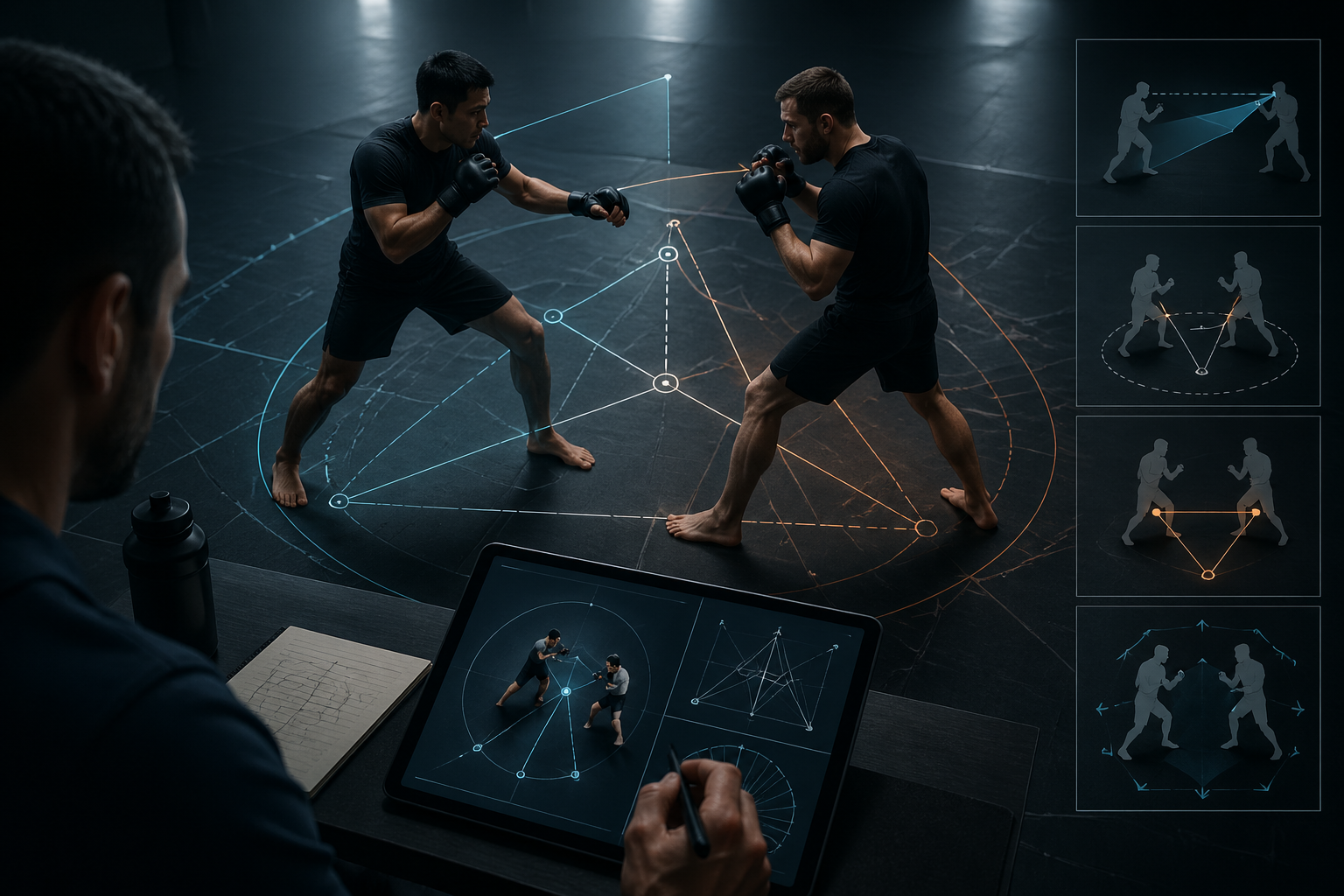
Geometry is how you see space, lines, angles, and exits when the pace gets ugly. In martial arts, that means reading pressure early enough to stay balanced, keep choices open, and avoid getting trapped in a bad exchange.
Read this first
- Pressure changes what you notice before it changes what you can do.
- The first loss is often space, posture, or vision, not technique.
- A good read is simple: what closed, what stayed open, and what reset brings you back to a workable position.
What geometry means in a fight
In martial arts, geometry means the shape of the exchange. It is the angle of your entry, the line of your exit, the space between hips and shoulders, and the route your opponent is trying to cut off.
A fighter who sees geometry well does not just look at the strike in front of them. They notice where the next step can go, where the corner is forming, and which line is getting crowded. Spiral Combat treats that kind of reading as a core part of Fight IQ.
This matters because pressure usually works by changing the shape of the exchange. Once the shape changes, the same technique may stop working the way it did a second ago.
Geometry is not decoration. It is the map of what stays available under pressure.
- Angle tells you who has the better line.
- Distance tells you what tools are still alive.
- Foot position tells you whether you can leave, return, or stay safe.
| Geometry cue | What it usually tells you | Why it matters |
|---|---|---|
| Angle closes | Your exit line is being cut off | You may need to step, pivot, or reset now |
| Distance compresses | The exchange is becoming crowded | Long tools and clean reactions get harder to use |
| Feet square up | Balance and mobility are dropping | You are easier to force, chase, or trap |
| Eyes fix on one target | Awareness is narrowing | You may miss the safer option |
| Hip line turns away | Power and structure are breaking down | Defense and counters get weaker |
What changes under pressure
Pressure changes the whole decision environment. Breathing gets louder, thinking gets faster, and the body starts favoring the most familiar reaction instead of the best one.
That is why the visible mistake is often the last mistake in the chain. The earlier change may be a rushed breath, a square stance, or a collapse in attention. By the time the strike misses or the defense breaks, the problem has already been building.
This is where geometry becomes useful. It gives you something concrete to track while the pace rises: where the space went, which line closed first, and what shape the body took when the exchange got hard.
The first loss is often perception. The body follows later.
- Look for the first breath change.
- Watch for feet that stop moving with purpose.
- Notice when the eyes stop scanning and lock onto one threat.
| Pressure sign | What it often means | Cleaner coaching read |
|---|---|---|
| Rushed breathing | The nervous system is spiking | Slow the pace and recover one clear breath |
| Square feet | Mobility is shrinking | Rebuild stance and angle before re-entering |
| Fixed eyes | Awareness is narrowing | Restore scanning before adding offense |
| Forcing the action | The fighter is trying to win space by will alone | Return to position, then attack |
The hidden decision problem
Most fighters do not think, I am making bad choices right now. It feels automatic. They lunge, shell up, freeze, or chase because the pressure has already changed what feels possible.
That is the hidden decision problem. The menu of choices gets smaller before the person notices it. A good coach or self-review asks a different question: what changed first, and which option disappeared first?
Geometry helps here because it turns a vague feeling into something you can point to. If the angle is gone, the exit is gone. If the base is broken, the counter is gone. If the vision narrows, the safer read is gone.
Good fight IQ is not just knowing more. It is keeping enough clarity to choose from the right options.
- Lost angle often leads to forced entries.
- Lost base often leads to ugly defense.
- Lost vision often leads to late reactions.
| What disappeared first | Typical result | Better response |
|---|---|---|
| Exit line | Panic or chasing | Recover angle or step off line |
| Stable base | Overcommitted movement | Set the feet and rebuild posture |
| Readable space | Smothered exchanges | Create a beat before re-entering |
| Clear vision | Tunnel focus | Scan before throwing again |
What to notice first
Start with the first cue, not the final mistake. If you wait until the scramble is fully broken, you are coaching the ending instead of the cause.
The best first cues are plain and physical: breath getting sharp, feet crossing, shoulders rising, or eyes stopping their scan. These are easier to catch than a dramatic collapse, and they give you more time to act.
Once you can name the cue, the correction gets smaller. You are no longer trying to fix the whole exchange. You are trying to restore one workable state.
Look for the first readable change, not the loudest failure.
- Breath changes before panic shows on the face.
- Feet cross before balance is lost.
- Shoulders rise before the body gets stiff.
- Eyes lock before the options disappear.
| First cue | What it often signals | What to do next |
|---|---|---|
| Breath sharpens | Stress is rising | Slow one beat and re-center |
| Feet square | Mobility is dropping | Step to a better line |
| Eyes lock | Awareness is narrowing | Scan before committing |
| Shoulders rise | Structure is tightening | Relax enough to keep options open |
A practical way to train it
Train the skill with one cue, one reset, and one review question. Keep it that simple.
The cue tells you pressure is rising. The reset is the small action that brings you back to a usable shape. The review question tells you what changed first so the lesson sticks.
This works in live rounds, drills, film study, and coaching notes. The point is not to make the exchange slow. The point is to keep the mind readable while the pace stays real.
Simple beats clever when the round gets hard.
- Cue: notice the first pressure sign.
- Reset: step, breathe, pivot, or frame.
- Review: what disappeared first?
| Part of the loop | Example | Why it helps |
|---|---|---|
| Cue | Eyes stop scanning | You catch the narrowing early |
| Reset | Small exit step | You regain space without freezing |
| Review | What option disappeared? | You learn the pattern instead of just the result |
Examples you can use right away
Examples make the idea real. A fighter does not need a theory lesson in the middle of sparring. They need a clear read and a better next action.
Use these patterns as starting points in training or film review. Then replace them with the situations your own team sees most often.
The key is to connect the shape of the exchange to the behavior that follows. When the shape changes, the choice set changes too.
Do not study the mistake in isolation. Study the shape that produced it.
- Chasing after a missed strike often means the fighter lost patience and angle at the same time.
- Shelling up too early often means the fighter stopped seeing exits before the contact arrived.
- Feeling rushed often means the fighter lost the beat before the technique failed.
| Situation | What it usually means | Cleaner next move |
|---|---|---|
| Chases after a miss | Patience and angle are gone | Reset the feet, breathe, then re-enter |
| Shells up too early | The fighter sees only danger | Name one exit before adding offense |
| Feels rushed | Timing has collapsed | Slow the drill and find the first cue |
| Keeps crowding the line | Space is being wasted | Angle out and make the space visible again |
A coachable way to think about it
A good coaching question is not, Do you understand geometry? The better question is, What changed in the room before the bad choice appeared?
That shifts the talk from abstract ideas to usable clues. It also gives the athlete something they can hear, repeat, and work on in the next rep.
Spiral Combat leans on that kind of language because it helps fighters build cleaner Fight IQ. You are teaching them to read the room, not just throw harder inside it.
The best coaching language points to what changed, not just what went wrong.
- Ask what changed first.
- Ask what option disappeared.
- Ask what reset would make the next rep cleaner.
| Bad coaching line | Better coaching line |
|---|---|
| Why did you do that? | What changed before that happened? |
| Be calmer. | What would give you one better option right now? |
| Stop rushing. | Which cue told you the pace was getting away from you? |
A seven-day practice plan
Keep the practice small. A short loop done honestly is better than a big plan that never gets used.
Use one round, one clip, or one drill per day. Write down the cue you noticed, the reset you tried, and the lesson you would carry into the next session.
By the end of the week, you should have a clearer personal map of how pressure shows up in your body and your decisions.
Seven short days can change how you read pressure if you review honestly.
- Day 1: Watch one round and note the first cue.
- Day 2: Pick one cue that appears before the mistake.
- Day 3: Choose one reset you can use live.
- Day 4: Test cue and reset in a drill.
- Day 5: Compare one clean moment and one broken moment.
- Day 6: Write one coaching sentence from the pattern.
- Day 7: Decide what to study next.
| Day | Action | Goal |
|---|---|---|
| 1 | Watch one round | Spot the first cue |
| 2 | Choose one cue | Make the read sharper |
| 3 | Pick one reset | Build a usable response |
| 4 | Test in a drill | See if it works under speed |
| 5 | Compare two moments | Learn what changes the shape |
| 6 | Write one sentence | Turn the lesson into language |
| 7 | Plan the next study | Keep the loop going |
Common mistakes and better fixes
Most people do not fail because they lack effort. They fail because they treat the idea like theory instead of a working tool.
The fixes below keep the work grounded. They help the fighter move from broad advice to a repeatable habit.
This is the standard Spiral Combat aims for: pressure made readable, then trainable, then reviewable.
If the fix is too big, the fighter cannot use it under stress.
- Mistake: trying to fix everything at once. Fix: choose one cue, one reset, and one review question.
- Mistake: mistaking intensity for clarity. Fix: ask whether the extra effort actually created better options.
- Mistake: leaving the lesson in the abstract. Fix: attach it to a round, clip, or coaching note.
- Mistake: skipping the review. Fix: write down what changed first and what disappeared next.
| Mistake | Why it fails | Better fix |
|---|---|---|
| Fixing everything | Too much to track under pressure | Use one cue, one reset, one review |
| Confusing effort with clarity | Harder does not always mean better | Check whether options improved |
| Staying abstract | No link to real training | Tie it to a real round or clip |
| No review | Lesson fades fast | Write the pattern down right away |
Reader checklist
Use this checklist before you move on. It tells you whether the idea stayed interesting or actually became usable.
A good article should leave you with a cleaner read, a smaller correction, and a better next rep.
If you cannot check these boxes, the work is not done yet.
A useful lesson gives you something to notice, something to do, and something to review.
- Can I explain the idea in one plain sentence?
- Can I point to a real pressure cue?
- Do I know what reset I would try next?
- Did I get one concrete next step?
- Do I know what I would watch for in the next round?
| Check | Yes means |
|---|---|
| One-sentence explanation | You can teach it simply |
| Real cue identified | You can spot pressure earlier |
| Next reset chosen | You have a usable response |
| Next step clear | The lesson can enter training |
A seven-day practice plan
Use this as a simple way to turn the idea into a week of practice, film study, or coaching notes.
| Step | Action |
|---|---|
| Day 1 | Watch one round or clip and write the first pressure cue you notice. |
| Day 2 | Choose one cue that appears before the mistake, not after it. |
| Day 3 | Pick one reset you can use while the exchange is still live. |
| Day 4 | Test the cue and reset in a controlled drill or slow review. |
| Day 5 | Compare one moment where options opened and one where they closed. |
| Day 6 | Write the cleanest coaching note or self-review sentence you can. |
| Day 7 | Decide what deeper lesson, clip study, or training topic comes next. |
Common mistakes and better fixes
Most mistakes come from reading the moment too late or trying to solve too much at once.
| Mistake | Better fix |
|---|---|
| Trying to fix everything at once | Use one cue, one reset, and one review question for the next session. |
| Confusing effort with clarity | Check whether the extra effort actually created better options. |
| Turning the topic into theory only | Tie it to a real round, clip, or coaching note. |
| Skipping the follow-up | Write down what changed first and what disappeared next. |
Reader checklist
- I can explain the idea in one plain sentence.
- I can name a real pressure cue.
- I know what reset I would try next.
- I have one concrete next step for training or film study.
- I know what to watch for in the next round.
Next Spiral Combat path
Next, move from geometry into how pressure changes timing and decision speed in live exchanges.
Related Spiral Combat reading
FAQ
What is the simplest way to study pressure in martial arts?
Pick one round, one cue, and one reset. Watch for the first sign that space, balance, or vision is changing, then note what option disappeared first.
What should I watch first when pressure builds?
Start with the first physical change: breathing, foot position, shoulder tension, or eye focus. Those cues show up before the obvious mistake.
How does geometry help fight IQ?
It gives you a clearer picture of lines, distance, exits, and angles, so you can make cleaner decisions instead of reacting late.
What is a good reset during live training?
A small step, a breath, or a pivot that restores space and structure without stopping the exchange.
What should I review after sparring?
Ask what changed first, what you stopped seeing, and what option was still available but no longer felt available.
Key takeaways
- Geometry helps you read the shape of pressure, not just the strike in front of you.
- The first loss is often attention, space, or structure.
- One cue, one reset, and one review question is enough to start.
- Good Fight IQ means seeing what changed before the obvious mistake.
- The best coaching language points to the state underneath the symptom.