
Table of contents
- Read this first
- What changes when pressure rises
- The hidden decision problem
- What to notice first
- How to train it without making it complicated
- Examples you can use right away
- A coachable way to think about it
- What this is not saying
- A seven-day practice plan
- Common mistakes and better fixes
- Reader checklist
- Next Spiral Combat path
- Related Spiral Combat reading
- FAQ
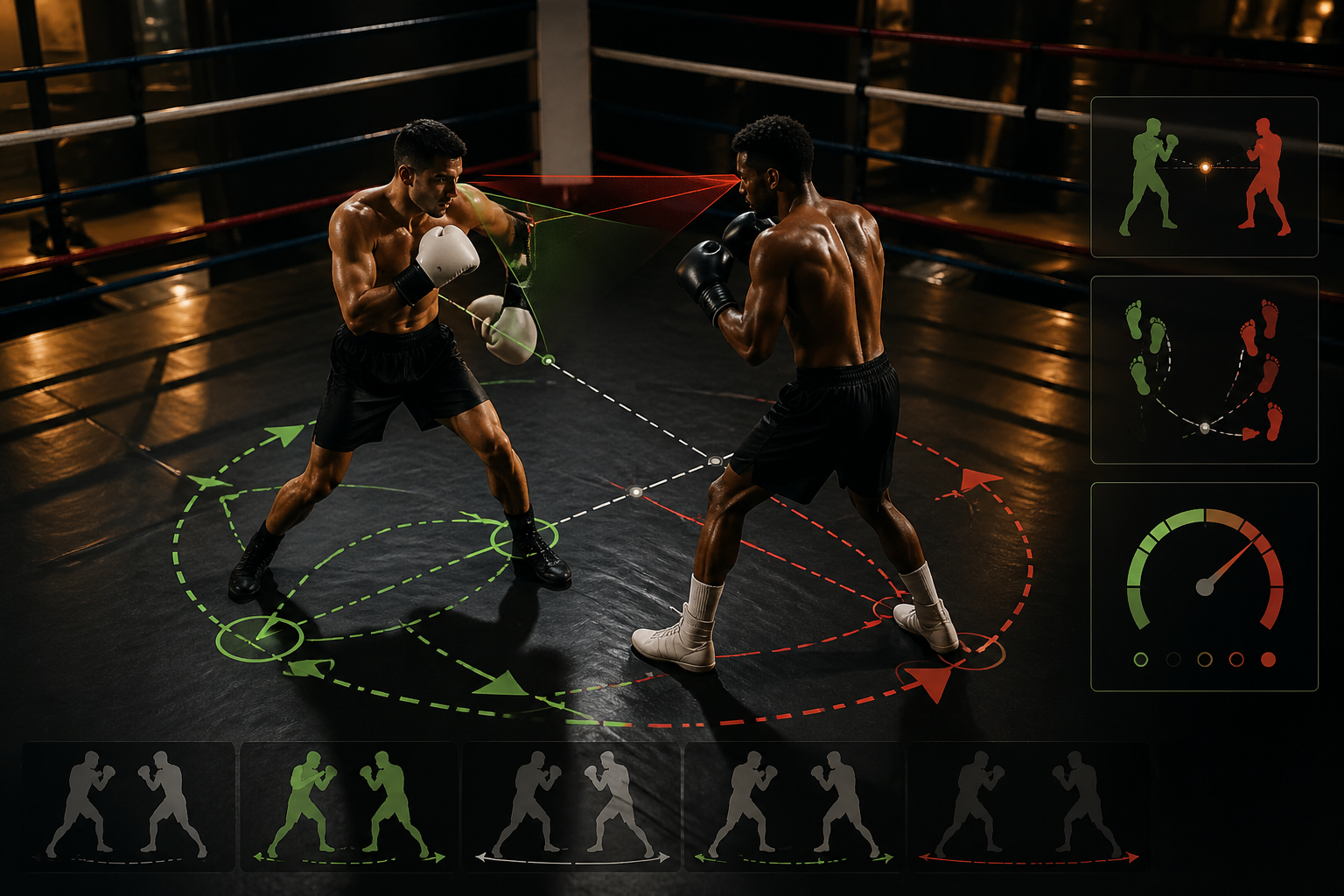
Direct answer: Boxing footwork and angle control matter because they help you see pressure early, keep your balance usable, and exit or re-enter before the exchange turns messy. The real skill is not moving a lot. It is noticing when your space, timing, or attention starts to narrow, then making a small clean adjustment before you lose the next option.
Good footwork is not just movement. It is how you keep your choices alive when pressure starts closing space.
Read this first
- Pressure usually shows up first in attention, breath, and posture, not in the final missed punch.
- Angle control is about changing the opponent’s line while protecting your own balance and exits.
- The best reset is often small: a step, a pivot, a frame, or a breath that restores readable structure.
- If you cannot name the first sign of trouble, you are usually reacting too late.
- Fight IQ grows when you can review one exchange and identify what changed before the visible mistake.
What changes when pressure rises
Pressure changes what the fighter notices first. The mind narrows. Breathing gets louder. The feet get less honest. A boxer can still look active while quietly losing access to the space and timing that would solve the exchange.
That is why footwork matters so much. Good feet do not just move you around the ring. They keep your options visible. They let you step off the line, return to position, or claim a new angle without rushing into damage.
Angle control is part of the same problem. If you can change the line of attack, you can make the other person work harder for a clean look. If your feet get square or heavy, you hand them a clearer target and fewer problems to solve.
The first loss is often not the exchange. It is the loss of clean perception.
- Rushed breathing can be the first sign of rising pressure.
- Square feet often mean the fighter is ready to trade, not ready to solve.
- Locked eyes usually mean the fighter has stopped scanning for the next exit.
- A late step is often a sign that the decision was already delayed.
| Change you can see | What it often means | What to do next |
|---|---|---|
| Breathing gets short | Stress is rising before the technique breaks | Reset the breath and reduce the pace |
| Feet square up | The fighter is giving up angle and balance | Step off line and recover stance |
| Eyes lock on one target | Attention is narrowing | Scan, then move or frame |
| Hands get busy but body stays planted | Movement has replaced positioning | Move the feet before adding offense |
The hidden decision problem
Most fighters do not feel like they are choosing badly in the moment. It feels faster and more automatic than that. They chase, shell up, overcommit, or freeze because the pressure has already changed the decision environment.
That is the real Fight IQ problem. Not knowledge alone, but access. Can you still access the right option when your breathing changes, your timing gets crowded, and your reading gets noisy?
Boxing footwork and angle control help because they keep the next choice from disappearing. A small step can restore a clean read. A pivot can buy time. A reset can make the next exchange easier to understand.
The goal is not perfect control. The goal is enough structure to choose well one more time.
- Pressure can make a simple option feel unavailable.
- A bad position often starts as a bad read.
- The body usually follows the decision environment already built by the mind.
- The cleaner the reset, the more likely the next choice stays useful.
| Decision layer | What to watch | Why it matters |
|---|---|---|
| Attention | Where the eyes and mind lock up | Narrow attention hides exits |
| Breath | Whether the body is speeding up | Breath often shifts before technique fails |
| Posture | Whether the spine and hips stay usable | Posture decides how easy it is to move |
| Feet | Whether stance stays balanced | Feet decide whether the next move works |
| Exit | Whether there is a real way out or around | A lost exit turns a good idea into a scramble |
What to notice first
Start with the earliest visible cue, not the biggest mistake. Look for rushed breathing, square feet, late exits, eyes stuck on one target, or the sudden urge to force an opening.
Once you can see the first cue, the correction gets smaller. You are no longer trying to fix the whole round. You are trying to recover a readable state.
That is a powerful coaching shift. Instead of yelling for everything at once, name the first signal and ask for one clean adjustment. The athlete gets something real to do, and the next exchange becomes easier to read.
If you can spot the first cue, you can often stop the next mistake from compounding.
- Watch the breath before the hands.
- Watch the feet before the head movement.
- Watch the eyes before the missed punch.
- Watch the exit before the scramble.
| First cue | What it suggests | Simple response |
|---|---|---|
| Short breath | Stress is rising | Slow the tempo and reset |
| Square stance | Angle is collapsing | Pivot or step off line |
| Locked gaze | Scanning has dropped off | Re-center vision and move |
| Late exit | Timing is slipping | Leave earlier on the next rep |
How to train it without making it complicated
Keep the work small: one cue, one reset, one review question. The cue tells you pressure is rising. The reset gives you a physical action. The review question tells you what actually changed.
For example, you might notice when your eyes stop scanning. Your reset might be a small pivot, a breath, or a step to a safer angle. After the round, ask one question: what option disappeared first?
This is simple on purpose. If the system gets too clever, fighters stop using it live. A clean reset beats a perfect theory every time.
Train the read, not just the motion.
- Use one cue you can actually notice under stress.
- Choose one reset you can perform live.
- Review one exchange instead of the whole round.
- Repeat the same pattern until it becomes familiar.
| Training piece | Purpose | Example |
|---|---|---|
| Cue | Alerts you to pressure | Eyes stop scanning |
| Reset | Restores a usable state | Small pivot and breath |
| Review question | Makes the lesson honest | What disappeared first? |
| Next rep | Tests whether the fix holds | Repeat with the same cue |
Examples you can use right away
Real examples make the idea easier to see. A fighter who chases after missing is often trying to recover status, not position. A fighter who shells too early may have narrowed their field of view and lost the sense of exits. A fighter who says they felt rushed may have lost the timing beat before the technique failed.
In each case, the fix is usually smaller than people expect. Reset the feet. Breathe. Reclaim an angle. Re-enter from a cleaner place. The point is not to force a dramatic correction. The point is to restore the conditions for a better decision.
If you coach, these examples give you language that is more useful than generic advice. You are not just saying ‘calm down.’ You are naming what got lost and what needs to come back.
Name the loss, then choose the next clean move.
- Chasing after a miss often means the fighter is trying to win the moment back too fast.
- Early shelling can mean the fighter has already given up too much space.
- Feeling rushed often points to a timing problem, not just a confidence problem.
- A small angle change can create more value than a hard lunge.
| Situation | What it usually means | Cleaner next move |
|---|---|---|
| Chasing after a miss | Panic is replacing the plan | Reset feet, breathe, re-enter |
| Shelling too early | Attention has narrowed to survival | Find one exit before adding offense |
| Feeling rushed | Timing has collapsed | Slow the drill and find the beat |
| Staying planted too long | Position has become stubborn | Step off line and recover shape |
A coachable way to think about it
The best question is not, ‘Do I understand this idea?’ The better question is, ‘What will this help me notice sooner?’ That keeps the topic tied to action.
For fighters, the answer might be simple: I will notice when my feet go square, when my eyes stop scanning, or when my breathing gets sharp. For coaches, the answer might be even more practical: I will know which cue to call out first.
That is the Spiral Combat lens. Pressure, geometry, rhythm, breath, and timing are all connected. The job is to make them readable enough that the next decision stays available.
Clarity is useful only if it changes the next rep.
- Ask what changed before the obvious mistake.
- Ask what option stopped feeling available.
- Ask which cue showed up first.
- Ask what the smallest clean correction was.
| Role | Best question | Good outcome |
|---|---|---|
| Fighter | What did I stop seeing? | Better self-correction |
| Coach | What got lost first? | Cleaner feedback |
| Reviewer | What changed before the mistake? | Better film study |
| Student | What should I watch next time? | Stronger habit formation |
What this is not saying
This is not a claim that mindset solves everything. Skill, conditioning, coaching, matchup quality, and physical reality still matter. Pressure is only one layer of the fight.
It is also not a call to slow down forever or become passive. Good footwork can still be fast. Good angle control can still be aggressive. The point is clearer action, not hesitant action.
A calm read can create a fast decision because the fighter is no longer solving three imaginary problems at once. That is the kind of intelligence under stress Spiral Combat cares about.
The aim is cleaner action, not softer action.
- Not every bad moment is a psychology problem.
- Not every reset should be dramatic.
- Not every answer needs more effort.
- Not every exchange should be treated the same way.
| Misread | Better view | Why it helps |
|---|---|---|
| “I just need more hype” | I need a clearer read | Clarity beats noise |
| “I should do more” | I should do the right small move | Less wasted motion |
| “I lost it mentally” | I lost a cue or exit first | Better diagnosis |
| “I need a bigger answer” | I need a cleaner reset | More usable under stress |
A seven-day practice plan
Use this as a simple way to turn the idea into a week of practice, film study, or coaching notes.
| Step | Action |
|---|---|
| Day 1 | Watch one round or clip and write down the first pressure cue you see. |
| Day 2 | Choose one cue that appears before the mistake, not after it. |
| Day 3 | Pick one live reset: a step, a pivot, a breath, or a frame. |
| Day 4 | Test the cue and reset in a slow drill or controlled round. |
| Day 5 | Compare one rep where space opened up and one where it closed down. |
| Day 6 | Write one coaching sentence or self-review note from the pattern. |
| Day 7 | Decide whether the topic should become a deeper study, drill, or lesson path. |
Common mistakes and better fixes
Most mistakes come from reading the moment too late or trying to solve too much at once.
| Mistake | Better fix |
|---|---|
| Trying to fix everything at once | Use one cue, one reset, and one review question for the next session. |
| Treating intensity as clarity | Ask whether the extra effort actually created better options. |
| Making the idea too abstract | Attach it to a real round, clip, or coaching note. |
| Skipping the review | Write down what changed before the visible mistake so the lesson sticks. |
Reader checklist
- Can I explain boxing footwork and angle control in one plain sentence?
- Can I point to the first visible signal in a real exchange?
- Do I know what a better reset would look like?
- Did this lesson give me a concrete next step?
- Can I use this in sparring, film study, or coaching without overthinking it?
Next Spiral Combat path
Next, continue with the Spiral Combat Codex on ring geometry, pressure reading, and the first clean reset after contact.
Related Spiral Combat reading
FAQ
What is the main purpose of angle control in boxing?
Angle control helps you change the line of the exchange so you can hit, defend, or reset from a better position while making the other person work harder for a clean shot.
What should I notice first when pressure rises?
Start with breath, stance, eyes, and exits. Those are often the earliest signs that the exchange is beginning to narrow.
How do I study pressure in a practical way?
Watch a round, find the first cue before the obvious mistake, then write down what option disappeared. Keep the review short and repeatable.
What is a good reset under pressure?
A good reset is small and usable live. A step off line, a pivot, a frame, or a breath can be enough if it restores structure.
How does this connect to Fight IQ?
Fight IQ is the ability to make better choices with less noise. Footwork and angle control help keep those choices available when the round gets messy.
Key takeaways
- Footwork is not just movement; it is how you preserve options under stress.
- Angle control helps you change the line while keeping your own structure usable.
- The first cue matters more than the final mistake.
- A small reset often beats a big correction.
- Better review creates better Fight IQ over time.