
Table of contents
- Read this first
- What pressure changes first
- The hidden decision problem
- What to notice first in live sparring
- A simple way to train this
- Common mistakes coaches and fighters make
- Examples you can use right away
- A coachable way to think about it
- A seven-day practice plan
- Common mistakes and better fixes
- Reader checklist
- A seven-day practice plan
- Common mistakes and better fixes
- Reader checklist
Direct answer: The most common sparring mistakes under pressure are not usually one bad strike or one bad defense. They start when attention narrows, posture collapses, breathing gets ragged, and the fighter stops seeing simple exits or resets. If you can notice that first shift early, you can recover faster and make the next exchange cleaner.
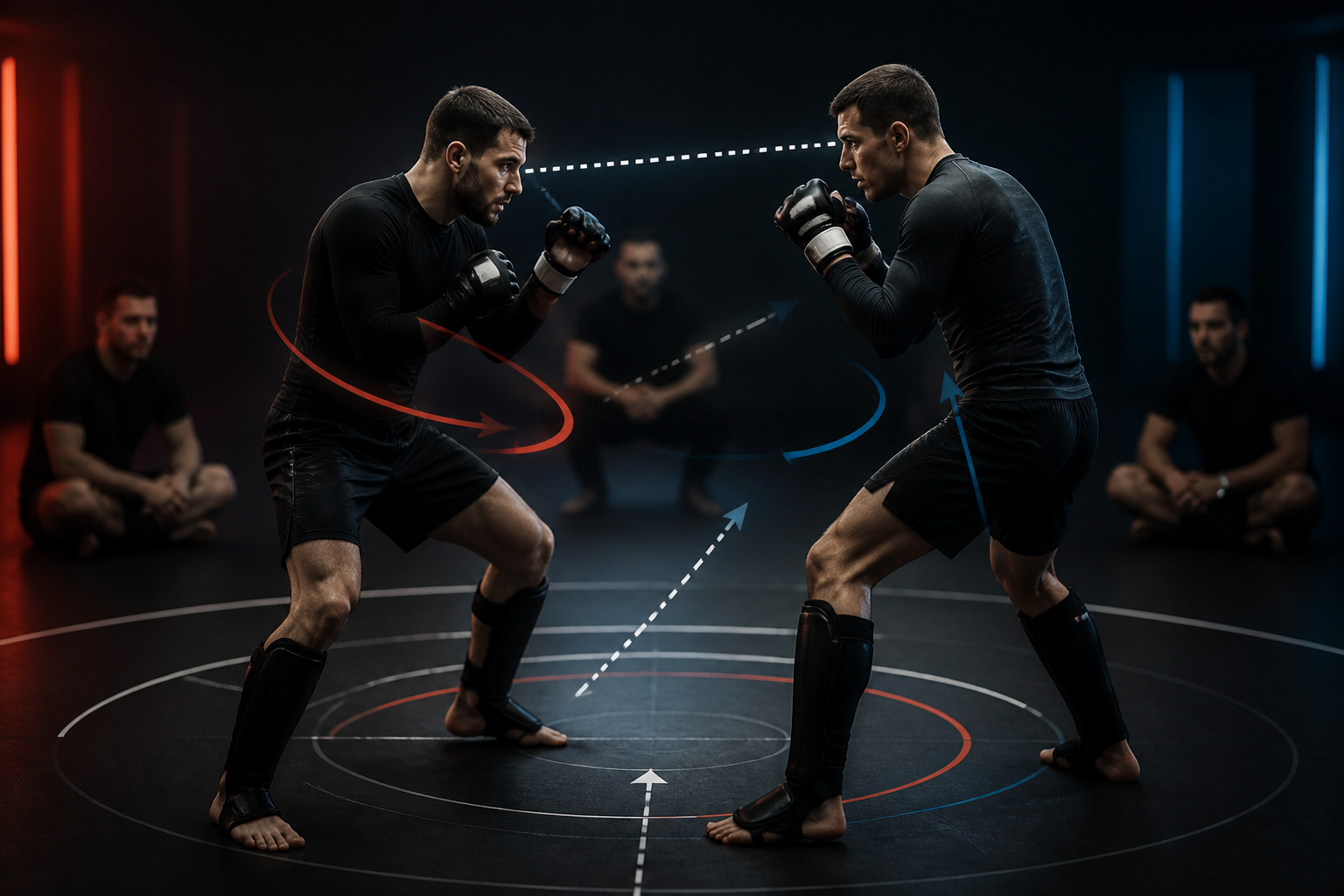
Under pressure, most sparring mistakes start before the obvious slip. The body rushes, the eyes lock, the breath changes, and the fighter loses access to simple options.
Read this first
- Pressure changes what the fighter notices first, not just what they throw.
- The first mistake is often a change in breath, stance, or attention.
- A small reset is better than trying to fix the whole round at once.
- Coaches should name the state, not just the symptom.
- Fight IQ grows when the athlete learns to read their own pressure pattern.
What pressure changes first
Pressure usually hits the mind before it shows up in the score. A fighter may still look active while their options are shrinking. They are moving, but they are no longer choosing well. That is why the early signs matter more than the loud mistake at the end.
The first things to go are often simple: breath gets short, feet get square, the eyes stop scanning, and the fighter starts forcing a reply. In Spiral Combat terms, the problem is not just the technique. It is the state behind the technique.
Watch the first change in state, not just the final error.
- Short breath
- Square stance
- Locked eyes
- Late exits
- Forced entries
| What changes | What it usually means | What to watch next |
|---|---|---|
| Breath gets tight | The fighter is losing calm and pace | Look for rushed actions or poor exits |
| Feet square up | Structure is slipping | Check whether balance and angles are still available |
| Eyes lock on one target | Attention has narrowed | See whether exits or counters disappear |
| Movement speeds up without purpose | Panic or urgency is taking over | Ask if the fighter is reacting or deciding |
The hidden decision problem
A fighter rarely thinks, I am making bad decisions now. It feels more automatic than that. They chase, shell up, overreach, or freeze because pressure has already changed what feels possible.
This is why Fight IQ is more than knowing combinations or having a bigger toolbox. It is the skill of keeping enough perception online to choose the right next action under stress. The fighter who still sees space, timing, and structure has more ways out than the fighter who is only trying to survive the moment.
Pressure often steals choices before it steals technique.
- Chasing replaces patience
- Shelling replaces reading
- Overcommitting replaces structure
- Waiting too long replaces initiative
| State | Common behavior | Better read |
|---|---|---|
| Panic | The fighter rushes forward | Ask what looked unsafe before the rush |
| Shutdown | The fighter becomes passive | Check whether they lost sight of an exit |
| Overcommitment | The fighter throws too hard or too long | Look for a broken base or lost balance |
| Embarrassment | The fighter tries to win the moment back fast | Slow the pace and restore one simple task |
What to notice first in live sparring
Start with the earliest readable cue. That may be a breath change, a foot that lands too square, a glance that stops scanning, or a sudden need to force contact. Those cues show up before the exchange falls apart.
Once you see the first cue, the correction gets smaller. You are no longer trying to fix everything. You are trying to restore one useful state: balance, vision, spacing, or timing. That is easier to coach and easier to repeat.
Find the cue that appears before the mistake, not after it.
- Breathing changes
- Feet stop moving with purpose
- Eyes stop tracking the whole space
- Hands drift high with no plan
- The fighter starts forcing contact
| First cue | Likely risk | Simple correction |
|---|---|---|
| Rushed breathing | Loss of calm and timing | Use one breath and reset the stance |
| Square feet | Loss of angle and balance | Exit, pivot, or step to restore shape |
| Locked eyes | Loss of awareness | Force a scan before re-entering |
| Forced pressure | Loss of patience | Pause, frame, or take one cleaner beat |
A simple way to train this
Use one cue, one reset, and one review question. That keeps the work clear enough to use in real rounds. The cue tells you pressure is rising. The reset gives you something physical to do. The review question turns the round into usable information.
For example: if your eyes stop scanning, reset with a small exit and one breath. After the round, ask what option disappeared first. That question matters more than a long speech about attitude.
One cue, one reset, one question.
- Cue: the first warning sign
- Reset: a small movement, breath, or frame
- Review: what option disappeared first?
| Part | Purpose | Example |
|---|---|---|
| Cue | Shows pressure is rising | Eyes stop scanning |
| Reset | Restores a readable state | Small exit and one breath |
| Review question | Makes the lesson specific | What option disappeared first? |
Common mistakes coaches and fighters make
The biggest mistake is treating composure like a personality trait. In reality, composure is often built from repeatable signals, recoverable positions, and honest review. It is a trained response, not a mood.
Another mistake is adding complexity when the athlete needs clarity. Under pressure, too many corrections can make the round noisier. A better coach names the state, points to the first signal, and gives one thing to recover.
Do not add noise to a noisy round.
- Treating calm as natural talent
- Giving too many corrections at once
- Ignoring the first readable cue
- Coaching only the visible error
| Mistake | Why it hurts | Better fix |
|---|---|---|
| Calling it personality | It stops training from improving | Treat composure as a skill |
| Overloading the athlete | It adds more confusion | Give one cue and one reset |
| Fixing only the final error | It misses the real cause | Name the earlier state change |
| Using vague advice | It is hard to repeat | Use plain, physical instructions |
Examples you can use right away
Examples make the idea real. In sparring, the fighter who chases after missing is often reacting to embarrassment, not strategy. The fighter who shells too early may have narrowed attention to survival. The fighter who says they felt rushed may have lost timing before technique broke.
These are not the same problem. That is the point. Different states need different corrections. A coach who can tell the difference can give a smaller, cleaner answer.
Name the state behind the mistake.
- Chasing after a miss often means the fighter wants to recover pride quickly.
- Shelling early often means the fighter stopped reading and started hiding.
- Feeling rushed often means timing broke before the technique did.
- Freezing often means the athlete lost a clear next task.
| Situation | What it may mean | Better next move |
|---|---|---|
| Athlete chases after missing | Status panic | Reset the feet and re-enter from structure |
| Athlete shells up too soon | Attention narrowed to survival | Name one exit or frame before attacking |
| Athlete says they felt rushed | Timing collapsed early | Slow the drill and find the first timing cue |
| Athlete freezes after pressure lands | No clear next task | Give one simple action to restore direction |
A coachable way to think about it
The useful question is not, Do I understand pressure? The useful question is, What will I notice sooner next time? That is a much better coaching question because it points to action.
This is also where Spiral Combat’s lens helps. Pressure, geometry, timing, perception, and consequence are connected. If one piece changes, the others usually follow. The job is to read the change early enough to respond cleanly.
Ask what you will notice sooner, not what you already know.
- What changed first?
- What option disappeared?
- What reset is still available?
- What should the next rep test?
| Coaching question | Why it helps |
|---|---|
| What changed first? | It points to the earliest signal |
| What option disappeared? | It shows the cost of pressure |
| What reset is still available? | It keeps the answer practical |
| What should the next rep test? | It turns insight into training |
A seven-day practice plan
Keep the plan small. The goal is not to solve pressure in a week. The goal is to build a habit of noticing it earlier and responding with less noise.
Use one round, one clip, or one drill per day. Write short notes. The review should be fast enough that you will actually do it again tomorrow.
Short notes beat long theory.
- Day 1: Watch a round and name the first pressure cue.
- Day 2: Pick the cue that shows up before the mistake.
- Day 3: Choose one reset you can use live.
- Day 4: Test the cue and reset in a slow drill.
- Day 5: Compare one clean round and one messy round.
- Day 6: Write one coaching sentence or self-correction note.
- Day 7: Decide what pattern deserves deeper work.
| Day | Action | Goal |
|---|---|---|
| 1 | Find the first cue in a round or clip | Build awareness |
| 2 | Choose the earliest warning sign | Avoid late corrections |
| 3 | Select one reset | Make recovery simple |
| 4 | Test it under controlled pressure | See if it holds up |
| 5 | Compare clean and messy reps | Spot the pattern |
| 6 | Write one short note | Make the lesson stick |
| 7 | Plan the next step | Keep the learning going |
Common mistakes and better fixes
Most people do not fail because they lack effort. They fail because the idea stays too broad. Pressure gets easier to work with when it is broken into a cue, a state, and a response.
The fix is simple: make the note smaller, the cue earlier, and the reset clearer. That is how the lesson moves from interesting to useful.
Small fixes are easier to repeat under stress.
- Too broad: fix everything at once
- Too late: wait for the obvious mistake
- Too vague: use weak coaching language
- Too abstract: keep it tied to a real round
| Mistake | Better fix |
|---|---|
| Trying to fix everything at once | Use one cue, one reset, one review question |
| Only reacting after the obvious error | Look for the first warning sign |
| Using fuzzy advice | Say exactly what to do physically |
| Leaving it as theory | Tie it to a round, clip, or drill |
Reader checklist
Use this list to see whether the topic turned into something you can actually use. If you can answer these clearly, you are reading pressure better than before.
The goal is not perfect insight. The goal is a cleaner next rep.
If you cannot answer these, keep studying the clip or round.
- Can I name the first visible cue before the mistake?
- Can I explain what changed in breath, stance, or attention?
- Do I know one reset that brings back structure?
- Can I tell the difference between panic, shutdown, and overcommitment?
- Do I have one next rep to test?
| Check | What good looks like |
|---|---|
| First cue | You can name the earliest warning sign |
| State | You know what pressure did to the athlete |
| Reset | You have one physical correction |
| Next rep | You know what to test next |
A seven-day practice plan
Use this as a simple way to turn the idea into a week of practice, film study, or coaching notes.
| Step | Action |
|---|---|
| Day 1 | Watch one round or clip and name the first pressure cue. |
| Day 2 | Pick the cue that shows up before the mistake. |
| Day 3 | Choose one reset that can happen in live sparring. |
| Day 4 | Test the cue and reset in a controlled drill. |
| Day 5 | Compare one clean exchange and one messy exchange. |
| Day 6 | Write one short coaching note or self-review sentence. |
| Day 7 | Decide whether the pattern needs deeper work in the next session. |
Common mistakes and better fixes
Most mistakes come from reading the moment too late or trying to solve too much at once.
| Mistake | Better fix |
|---|---|
| Trying to fix everything at once | Choose one cue, one reset, and one review question. |
| Waiting for the obvious mistake before reacting | Look for the first warning sign instead. |
| Using vague coaching language | Say exactly what the athlete should do with the body. |
| Turning the topic into theory only | Tie it to a real round, clip, or drill. |
Reader checklist
- I can name the first cue before the mistake.
- I can explain what changed in breath, stance, or attention.
- I know one reset that restores structure.
- I can tell panic, shutdown, and overcommitment apart.
- I have one next rep to test.
Next Spiral Combat path
Continue with the Spiral Combat Codex to connect pressure, geometry, and timing into one readable system.
Related Spiral Combat reading
FAQ
What is the first thing to look for under pressure?
Look for the earliest change in breath, stance, or attention. Those cues usually appear before the visible mistake.
How should a coach study pressure in sparring?
Use a simple loop: find one cue, name the state behind it, and give one reset that the fighter can repeat live.
Why do fighters make the same mistake when the pace rises?
Because pressure changes what feels available. The fighter may still know the right answer, but they no longer feel it in time.
What is the best reset when the exchange starts to slip?
Use the smallest useful reset you can repeat under stress, such as a breath, step, frame, or angle change.
Key takeaways
- Pressure usually changes attention before it changes technique.
- The first cue is more useful than the final mistake.
- One reset is better than a dozen corrections.
- Coaching works best when it names the state, not just the error.
- Fight IQ grows through clearer reading, not louder effort.