
Table of contents
- Read this first
- What distance really does
- The hidden decision problem
- What to notice first
- A practical way to train it
- Examples you can use right away
- A coachable way to think about it
- A seven-day practice plan
- Common mistakes
- What this is not saying
- A seven-day practice plan
- Common mistakes and better fixes
- Reader checklist
- Next Spiral Combat path
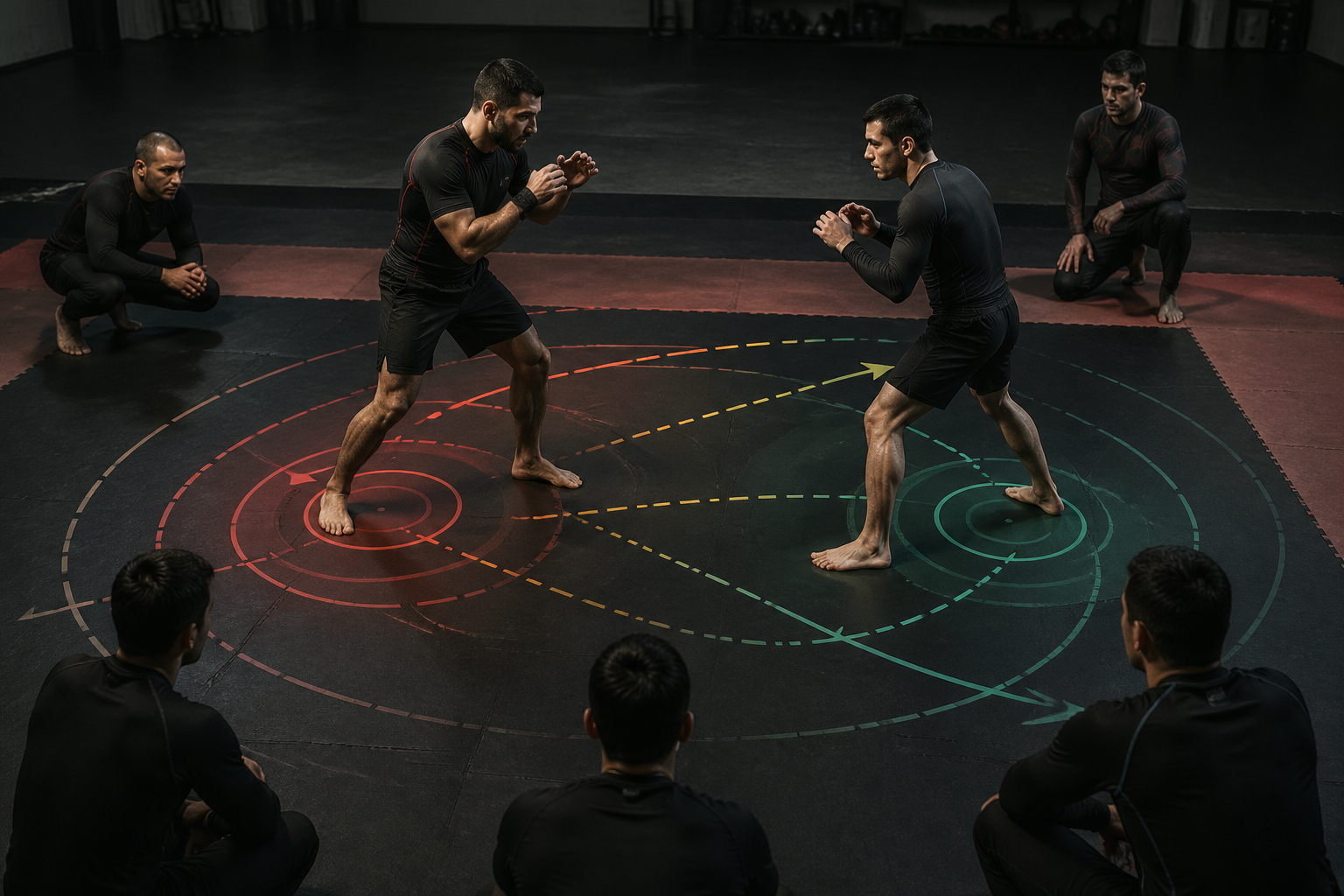
Direct answer: Fighters use distance to create options by staying at a range where they can see, move, and respond before the other person settles in. Good distance gives you time to read pressure, keep your structure, and choose a better next action instead of reacting from panic.
Distance is not just space. In fighting, it is a decision tool. The fighter who manages range well can see more, force worse entries, and keep the next exchange from closing down too fast.
Read this first
- Distance is not passive. It is a way to shape what the other fighter can reach and when.
- The first problem is usually perception, not technique. Once pressure narrows attention, options disappear fast.
- A small reset often solves more than a big effort. A better angle, a cleaner step, or a calmer breath can bring choices back.
- Range only helps if you can use it under stress. The real test is whether you still see exits when the exchange speeds up.
What distance really does
Distance gives a fighter room to read, move, and make the other person work harder for contact. It changes who has initiative and who has to reach first.
When you hold the right range, the opponent has to show their hand. They must step, extend, or commit before they can land cleanly. That delay creates information. Information creates options.
This is why distance is part of fight IQ, not just footwork. A smart fighter is not always trying to be closer. They are trying to be closer on their terms.
Distance is useful because it buys time, and time gives you choices.
- Too close: fewer exits, less read time, more rushed decisions.
- Too far: weak threats, slow counters, easy reset for the opponent.
- Just right: enough room to see, enough pressure to matter, enough balance to move again.
| Range problem | What it usually looks like | What it costs |
|---|---|---|
| Crowded range | Hands and feet jam up, exits disappear | Clean defense and clean offense |
| Lazy outside range | Both fighters wait and watch | Initiative and pressure |
| Managed range | The fighter can step, frame, feint, or counter | More paths to the next exchange |
The hidden decision problem
Most fighters do not lose options because they suddenly forget technique. They lose them because stress changes what feels available.
Under pressure, attention narrows. Breathing gets faster. The body wants the fastest answer, not the best one. That is when a fighter starts chasing, shelling, freezing, or reaching.
Distance matters here because it gives the mind a little room to stay organized. When range is managed well, the fighter can still think in terms of exits, frames, angles, and timing instead of only survival.
The real battle is often over what the fighter still thinks is available.
- Pressure can make normal space feel smaller than it is.
- Rushed breathing often comes before rushed technique.
- A fighter may still be moving while losing the ability to choose.
| State | Typical effect | What distance can help with |
|---|---|---|
| Calm | Clear reads and easier timing | Selecting the best entry or exit |
| Rattled | Narrow attention and rushed choices | Buying enough space to reset |
| Overheated | Forcing action and missing cues | Restoring rhythm before re-entering |
What to notice first
Start with the first visible sign that the exchange is tightening. That might be square feet, locked eyes, a rushed breath, or a sudden need to force contact.
Do not wait for the big mistake. By then, the fighter is already inside a bad decision path. The useful skill is spotting the first narrowing of choice.
The more specific the cue, the easier the correction. A fighter does not need a lecture in the middle of a round. They need one sign they can recognize and one action they can repeat.
Look for the first narrowing, not the final error.
- Feet stop adjusting.
- Breath gets short.
- The eyes fix on one target.
- The fighter stops seeing exits.
- The fighter starts forcing the same attack twice.
| Early cue | What it often means | Clean response |
|---|---|---|
| Rushed breath | Stress is rising faster than control | Exhale, settle, re-check range |
| Square stance | Movement is getting slower | Angle out before re-entering |
| Locked eyes | Perception has narrowed | Scan, then choose the next lane |
A practical way to train it
Use one cue, one reset, and one review question. Keep the loop small enough to remember under fatigue.
The cue tells you pressure is building. The reset gives you a physical way to regain usable structure. The review question makes sure you learn from the round instead of just surviving it.
This works in shadowboxing, partner drills, bag work, and film study. The method is simple because the job is simple: notice earlier, recover faster, and re-enter with a better read.
Small training loops beat vague intentions.
- Cue: the first sign that range is collapsing.
- Reset: a step, frame, breath, or angle that restores space.
- Review question: what disappeared first?
| Part | Example | Why it helps |
|---|---|---|
| Cue | Eyes stop scanning | Tells you the mind is narrowing |
| Reset | Small exit step | Gives the body a new lane |
| Review | What option disappeared first? | Turns the round into usable feedback |
Examples you can use right away
Examples matter because fighters learn faster from situations than from slogans. A good example shows what changed, what got lost, and what to do next.
Use these as patterns, then replace them with your own rounds, clips, and coaching notes. The point is not to copy the example. The point is to see the structure behind it.
Each example is about a lost option, not just a bad moment.
- If the athlete chases after a miss, the problem is often panic, not effort. Reset the feet before re-entering.
- If the athlete shells up early, the problem is often narrowed attention. Name one exit before adding offense.
- If the athlete keeps saying they felt rushed, the problem may be range and timing, not toughness. Slow the drill and find the first cue.
| Situation | What it likely means | Better next move |
|---|---|---|
| Chasing after a miss | The fighter wants to recover the moment fast | Pause, regain balance, then enter from a cleaner angle |
| Shelling too early | The fighter has stopped reading the room | Frame, breathe, and re-open vision before trading |
| Feeling rushed every round | The fighter is late to the beat | Reduce speed and rebuild timing at a readable range |
A coachable way to think about it
The best coaching question is not, 'Did you understand the lesson?' It is, 'What will you see sooner next time?'
That question keeps the idea tied to action. It turns distance into a live read, not a theory. It also keeps fighters honest. If they cannot name the first cue, they are probably waiting too long to respond.
In the Spiral Combat lens, that is the whole point of Fight IQ: better perception under pressure, not just more information.
Ask what the fighter will notice sooner, not what they know in theory.
- What changed first?
- What option disappeared first?
- What could have restored space sooner?
| Coach question | What it reveals | Why it matters |
|---|---|---|
| What changed first? | The earliest pressure cue | Lets the coach intervene earlier |
| What disappeared first? | The lost option | Shows what the fighter could not access |
| What restored space? | The workable reset | Builds a repeatable response |
A seven-day practice plan
Use one week to make the idea concrete. The goal is not mastery. The goal is a better read under stress.
Keep the work light and honest. One good note a day is better than a perfect plan you never finish.
Seven days can build a real habit if the loop stays simple.
| Day | Action | Focus |
|---|---|---|
| Day 1 | Watch one round and write the first pressure cue you see | Notice earlier |
| Day 2 | Choose one cue that shows up before the mistake | Make the cue specific |
| Day 3 | Pick one reset you can use live | Restore usable space |
| Day 4 | Test the cue and reset in a slow drill | Link awareness to action |
| Day 5 | Compare one round where options grew and one where they shrank | See the pattern |
| Day 6 | Write one clean coaching note or self-review sentence | Make the lesson portable |
| Day 7 | Decide what deeper lesson this pattern points to | Choose the next study path |
Common mistakes
The most common error is treating composure like a personality trait. In reality, composure is a set of habits: how you breathe, where your feet land, what you notice, and how fast you recover.
Another mistake is trying to make the idea too complicated. If a fighter needs one clear read, do not give them five theories. Give them one cue and one response.
A third mistake is confusing intensity with clarity. Working harder is not the same thing as seeing better.
If the fighter cannot use the lesson in live action, the lesson is too vague.
- Making the idea broad instead of specific.
- Waiting for a full collapse instead of the first cue.
- Using motivation language when the athlete needs a physical reset.
| Mistake | Why it fails | Cleaner fix |
|---|---|---|
| Treating composure as personality | It cannot be trained clearly | Train cues, resets, and review |
| Trying to fix everything | The fighter cannot act on it mid-round | Use one target at a time |
| Confusing effort with clarity | More effort can mean more panic | Check whether the extra effort improved options |
What this is not saying
This is not saying distance solves every problem. Skill, conditioning, matchup style, and physical reality still matter.
It is also not saying a fighter should become passive or slow. The goal is cleaner action, not hesitation. Sometimes a calm read leads to a faster strike because the fighter is no longer trying to solve three problems at once.
The point is simple: better distance management helps a fighter stay aware long enough to make a good choice.
Clearer does not mean slower. It means less wasted motion.
- Distance is one tool, not the whole system.
- A good read still has to be backed by skill.
- Pressure can be managed, not wished away.
| Misread | Better reading |
|---|---|
| 'Stay far away forever' | Use range to shape choices, then enter with purpose |
| 'Be calm and do nothing' | Stay clear enough to act well |
| 'Technique alone will fix it' | Perception, timing, and structure all matter |
A seven-day practice plan
Use this as a simple way to turn the idea into a week of practice, film study, or coaching notes.
| Step | Action |
|---|---|
| Watch the next round or clip | Write down the first sign that pressure is changing the range. |
| Choose one reset | Pick a step, breath, frame, or angle that restores space quickly. |
| Run a short drill | Test the cue and reset at live speed, then slow speed. |
| Review one question | Ask what option disappeared first and why. |
| Repeat for one week | Keep the loop small until the read becomes automatic. |
Common mistakes and better fixes
Most mistakes come from reading the moment too late or trying to solve too much at once.
| Mistake | Better fix |
|---|---|
| Treating distance like passivity | Use range as a tool to shape timing, not as a place to disappear. |
| Waiting for the obvious mistake | Look for the first cue that the exchange is tightening. |
| Giving the fighter too many corrections | Use one cue, one reset, and one review question. |
| Confusing effort with control | Check whether the extra effort actually created better options. |
Reader checklist
- Can I explain the idea in one plain sentence?
- Can I name the first cue that shows pressure is changing the exchange?
- Do I know one reset that brings options back?
- Can I tell the difference between a bad action and the state that caused it?
- Did I leave with a drill, a note, or a question I can use next session?
Next Spiral Combat path
Next, study how fighters use angles to turn distance into a cleaner exit or entry.
Related Spiral Combat reading
FAQ
What is the simplest way to study pressure in fighting?
Watch for the first sign that the fighter stops seeing options. Do not start with the final mistake. Start with the breath, feet, eyes, or posture change that came first.
How do fighters use distance to create options in real exchanges?
They stay at a range where they can read, move, frame, or counter before the other person settles in. That extra space gives them more than one response.
Why does distance matter so much under pressure?
Pressure narrows attention. Good distance gives the fighter enough room to stay organized while the exchange is still live.
What should a coach look for first?
The first cue that the athlete is losing choice: rushed breath, square feet, fixed eyes, or a forced attack. That is the moment to cue a reset.
Key takeaways
- Distance is a decision tool, not just space.
- The first problem is usually perception under pressure.
- One cue and one reset are better than a pile of vague advice.
- Good distance helps fighters keep structure long enough to choose well.
- Fight IQ grows when the athlete can see the pressure state earlier.