
Table of contents
- Read this first
- What changes under pressure
- The hidden decision problem
- What to notice first
- A practical way to train it
- Common mistakes
- Examples you can use right away
- A coachable way to think about it
- A seven-day practice plan
- Common mistakes and better fixes
- Reader checklist
- A seven-day practice plan
- Common mistakes and better fixes
- Reader checklist
Direct answer: Read momentum shifts by watching for the first sign that pressure has changed the fighter’s options: breath gets rushed, feet square up, exits disappear, eyes lock, or the athlete starts forcing the action. Once that shift shows up, the job is not to fix everything. The job is to regain structure and make the next clear decision.
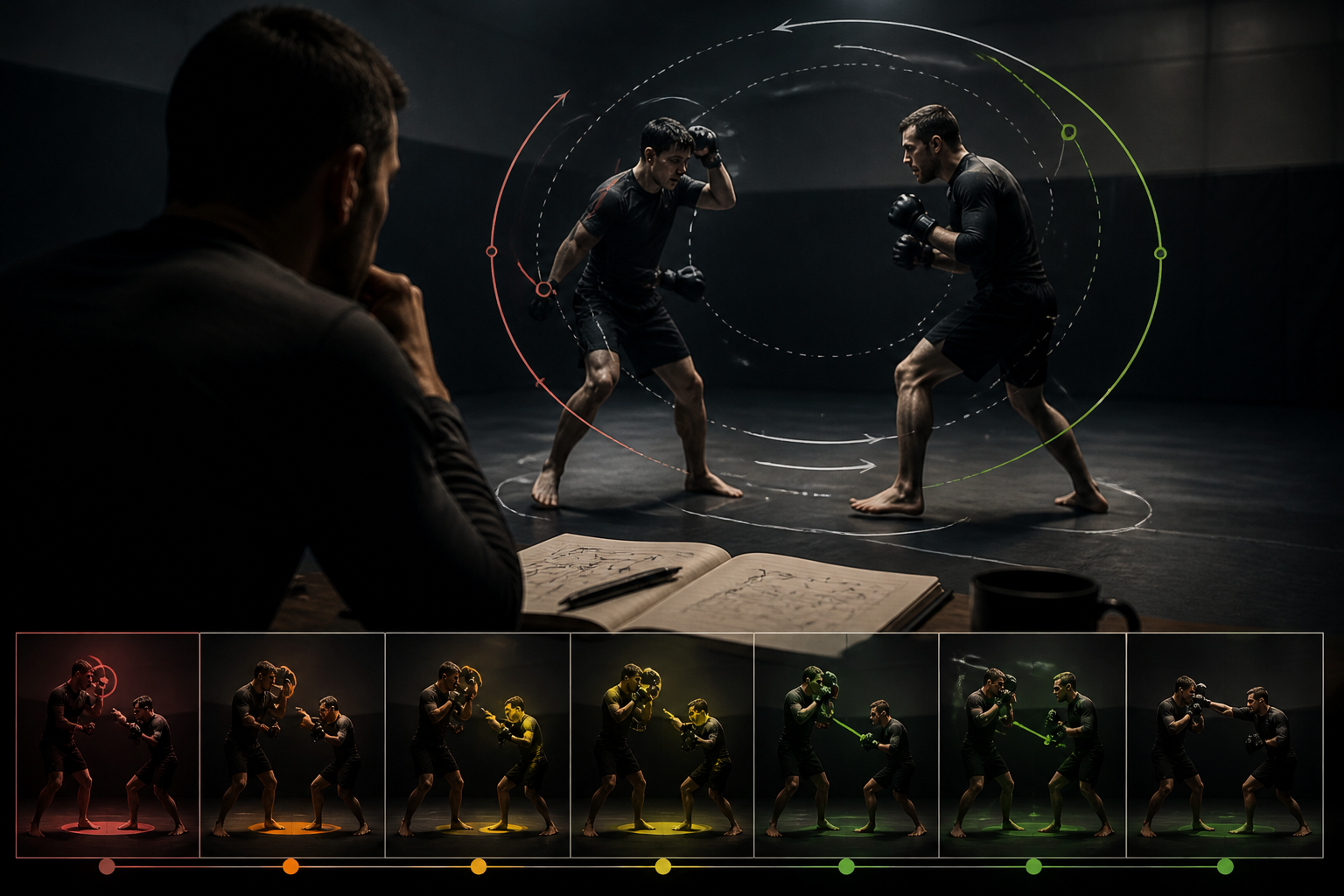
Momentum usually changes before the big mistake shows up. If you can read the first shift in breath, feet, eyes, or timing, you can make a cleaner decision before the exchange turns messy.
Read this first
- Pressure changes what a fighter notices before it changes what the crowd sees.
- The first warning sign is often small: breath, stance, eyes, or timing.
- A good read leads to one cleaner action, not a long theory.
- Momentum is about options. When options shrink, the fight starts to tilt.
- Fight IQ means seeing the shift early enough to respond on purpose.
What changes under pressure
Pressure does not just make people tense. It changes what they can perceive, what they can hold onto, and what they think is urgent.
A fighter can still look busy while the real problem is already underway: the feet get heavier, the breathing gets louder, and the mind starts narrowing around one threat or one goal.
That is why momentum is not only about who is landing. It is also about who still has access to exits, balance, and calm decision-making.
The visible mistake is usually the last thing to happen. The earlier clue is the change in state.
- Breath gets shallow or loud.
- Feet stop adjusting cleanly.
- The eyes stop scanning and fix on one target.
- The fighter starts reaching instead of setting up.
- The pace feels faster to one person even if the exchange is still readable.
| Signal | What it can mean | Why it matters |
|---|---|---|
| Breath changes | Stress is rising | The athlete has less room to think and adjust |
| Feet square up | Balance is slipping | Entries and exits get easier to punish |
| Eyes lock | Attention has narrowed | Other threats and opportunities get missed |
| Forcing attacks | Patience is breaking down | The fighter may be trying to win the moment back |
The hidden decision problem
Most fighters do not feel like they are choosing badly. They feel rushed, crowded, or behind.
That matters because the decision problem starts before the technique fails. Once the brain believes there is no time or space, the athlete begins picking from a smaller menu.
Good coaching and strong self-study should help the fighter notice when that menu shrinks. That is a real part of Fight IQ.
When the menu shrinks, the fighter does not need more moves. They need a clearer read and a smaller correction.
- Chasing often means the fighter feels behind.
- Shelling up too early often means the threat has taken over the mind.
- Freezing often means the athlete cannot see the next safe move.
- Overcommitting often means the fighter wants to force certainty.
- Waiting too long often means the athlete is stuck between caution and action.
| State shift | Common result | Cleaner response |
|---|---|---|
| Panic | Rush and reach | Reset the feet and re-establish a frame |
| Overcommitment | Long entries with poor exit | Shorten the action and protect the exit first |
| Freeze | No commitment | Name one safe option and act on it |
| Fatigue | Late reactions | Slow the problem down and simplify the task |
What to notice first
Start with the earliest readable cue, not the loudest one.
The first useful signal is often a change in breathing, a loss of stance integrity, a sudden fixation in the eyes, or a move that looks forced instead of chosen.
If you can spot the first change, you can make a smaller correction. You are not trying to solve the whole round. You are trying to recover one workable state.
Look for the first sign that the fighter is losing options, not the last sign that the exchange has already gone wrong.
- Breath: Did it get shallow, loud, or delayed?
- Feet: Did the base get square, narrow, or planted?
- Eyes: Did the gaze stop scanning?
- Timing: Did the fighter start early, late, or forced?
- Space: Did exits, frames, or angles disappear?
| Area | Question | What you want to see |
|---|---|---|
| Breath | Did the rhythm change first? | A steady, usable breath under stress |
| Feet | Did the base stay alive? | Small adjustments that keep balance |
| Eyes | Was the field still being read? | Scanning instead of fixation |
| Timing | Who owned the beat? | Clear initiative, not panic |
| Space | Was there still an exit? | One available next step |
A practical way to train it
Use a simple loop: one cue, one reset, one review question.
The cue tells you the shift is starting. The reset gives you a physical way back into structure. The review question tells you what changed first so you learn from the right moment.
This works in live rounds, technical drills, and film study. It keeps the idea concrete enough to repeat.
If the training cue is too broad, you will miss the moment. If the reset is too big, you will never use it under pressure.
- Cue: choose one early warning sign.
- Reset: choose one small action that restores posture or space.
- Review: ask what disappeared first.
- Repeat: test the same pattern across several rounds or clips.
| Part of the loop | Example | Purpose |
|---|---|---|
| Cue | Eyes stop scanning | Catch the shift early |
| Reset | Small exit and breath | Restore structure |
| Review | What option disappeared first? | Turn the moment into usable feedback |
Common mistakes
A lot of fighters make the same errors when they try to read momentum.
The first is treating composure like personality, as if calm people are born that way and everyone else is stuck. The second is waiting for a dramatic collapse instead of watching the small signs that come first.
Another mistake is trying to add more complexity when the real need is a simpler read. Under pressure, clarity beats cleverness.
The goal is not to look relaxed. The goal is to keep enough structure to make a good next decision.
- Mistake: waiting for the obvious breakdown. Fix: watch the early cues.
- Mistake: using too many corrections at once. Fix: choose one reset.
- Mistake: confusing intensity with control. Fix: ask whether the fighter has more options.
- Mistake: studying only the end of the exchange. Fix: study the moment before it turned.
| Mistake | Why it hurts | Better fix |
|---|---|---|
| Chasing the big mistake | You arrive too late | Study the first shift |
| Overcoaching | The athlete cannot act clearly | Give one correction |
| Treating calm as natural | You miss the skill involved | Train repeatable resets |
| Ignoring the body | You miss the state change | Watch breath, feet, and eyes |
Examples you can use right away
Examples make the idea easier to use in real rounds.
A fighter misses, then rushes forward with square feet. That is often not just bad footwork. It is a state change: the athlete wants the moment back too fast.
Another fighter shells up after a hard touch and stops seeing the open side. The issue may not be fear alone. It may be narrowed attention. The correction is usually not a lecture. It is one clear cue, one reset, and one next look.
Ask what changed before the bad action. That is usually where the useful lesson lives.
- Chasing after a miss often means panic has replaced the original plan.
- Freezing after contact often means the fighter has lost the next read.
- Forcing a finish often means the athlete is trying to recover control quickly.
- Looking flat after pressure often means the body has stopped making small adjustments.
| Situation | What it usually means | Cleaner next move |
|---|---|---|
| The athlete chases | The plan got replaced by urgency | Reset the feet, breathe, and re-enter with shape |
| The athlete shells up | Attention narrowed to threat only | Name one exit before adding offense |
| The athlete feels rushed | Timing is slipping | Slow the drill and identify the first cue |
| The athlete keeps forcing | Control feels lost | Take the smallest available clean action |
A coachable way to think about it
A coach should not ask only, ‘What went wrong?’ A better question is, ‘What changed first?’
That question helps separate the symptom from the state. A bad entry may be the symptom. The state underneath may be panic, fatigue, embarrassment, or the need to win the exchange back immediately.
Once you know the state, the correction gets sharper. The athlete gets one usable instruction instead of a vague demand to do better.
Small, specific coaching wins because pressure limits how much can be processed at once.
- Name the first change, not the last failure.
- Match the correction to the state.
- Keep the next action simple enough to repeat.
- Review the clip or round with one question at a time.
| Coaching question | What it reveals | Why it helps |
|---|---|---|
| What changed first? | The earliest sign of pressure | It finds the real problem |
| What did they stop seeing? | Attention loss | It shows where the read collapsed |
| What reset was still available? | A usable next step | It turns theory into action |
A seven-day practice plan
Keep the work small enough to finish.
You do not need to solve momentum in one session. You need repeated reps of noticing the shift, naming it, and responding with one clean reset. That is how the skill becomes usable under stress.
The point of the week is not mastery. The point is a better read by day seven than you had on day one.
- Day 1: Watch one round and write down the first pressure cue you notice.
- Day 2: Pick one cue that appears before the mistake.
- Day 3: Choose one reset you can use live.
- Day 4: Test the cue and reset in a slow drill.
- Day 5: Compare one moment of control with one moment of collapse.
- Day 6: Write one short coaching note or self-review sentence.
- Day 7: Decide what deeper lesson this pattern deserves next.
| Day | Focus | Output |
|---|---|---|
| 1 | Notice | One pressure cue |
| 2 | Select | One early warning sign |
| 3 | Reset | One live correction |
| 4 | Test | One controlled rep |
| 5 | Compare | Two moments with different outcomes |
| 6 | Write | One clear review note |
| 7 | Decide | The next study step |
Common mistakes and better fixes
Most people do not fail because they do not care. They fail because the idea stays too broad, too late, or too far from the next rep.
The fix is to keep the loop tight. One cue. One reset. One question. That is enough to build real pattern recognition over time.
If the review becomes a speech, the lesson will not stick.
- Mistake: trying to fix everything. Fix: focus on one cue.
- Mistake: studying only highlights. Fix: review the turn, not just the finish.
- Mistake: calling effort the same thing as control. Fix: measure whether options stayed available.
- Mistake: leaving the lesson abstract. Fix: attach it to a real round or clip.
| Bad habit | Better habit | Result |
|---|---|---|
| Too broad | One cue at a time | Clearer noticing |
| Too late | Watch the first shift | Earlier response |
| Too abstract | Use a real clip | Usable learning |
| Too much output | Short review | Better retention |
Reader checklist
Use this to check whether the idea turned into a usable skill.
If you can answer these clearly, you are no longer just reading about momentum. You are learning how to see it.
A good review should leave you with a better next rep, not just a better opinion.
- Can I name the first visible shift in a real exchange?
- Can I tell the difference between the symptom and the state?
- Do I know one reset I can use under live pressure?
- Can I explain the cue in plain English to a training partner or coach?
- Do I know what to watch in the next round or clip?
| Question | Yes means | No means |
|---|---|---|
| Can I name the first shift? | The pattern is becoming readable | I need more film or slower review |
| Do I know my reset? | I have a usable response | I only have theory |
| Can I explain it simply? | The lesson is mine | The lesson is still vague |
A seven-day practice plan
Use this as a simple way to turn the idea into a week of practice, film study, or coaching notes.
| Step | Action |
|---|---|
| Watch | Watch one round or clip and mark the first sign that pressure changed. |
| Choose | Choose one early cue, such as breath, feet, eyes, or timing. |
| Reset | Pick one small live reset that restores posture, space, or rhythm. |
| Test | Use the cue and reset in a controlled drill or slower round. |
| Review | Write one short note on what changed first and what option disappeared. |
| Refine | Keep the cue that works and drop the one that was too broad. |
| Repeat | Carry the same loop into the next session until the read gets faster. |
Common mistakes and better fixes
Most mistakes come from reading the moment too late or trying to solve too much at once.
| Mistake | Better fix |
|---|---|
| Waiting for the obvious collapse before reacting. | Watch the early change in breath, feet, eyes, or timing. |
| Trying to fix every problem at once. | Use one cue, one reset, and one review question. |
| Thinking intensity means control. | Check whether the fighter still had options. |
| Studying only the finish of the exchange. | Study the moment right before the turn. |
| Giving vague coaching like 'be calmer.' | Name the state and give one clean action. |
Reader checklist
- I can name the first visible pressure shift in a round.
- I can tell the difference between the symptom and the state.
- I have one reset I can use under live pressure.
- I can explain the idea in plain English to a teammate or coach.
- I know what to look for in the next clip, round, or sparring session.
Next Spiral Combat path
Next, study how to recover structure after pressure changes the exchange. That is the next layer of the Spiral Combat Fight IQ library.
Related Spiral Combat reading
FAQ
What is the simplest way to study pressure in training?
Use one clip or round, find the first cue that showed pressure was changing, then ask what option disappeared right after that. Keep the review short and repeat it across several sessions.
What is the first cue I should watch for?
Start with breath, feet, eyes, and timing. The exact cue can change by fighter, but those four areas usually reveal the shift early.
How do I coach this without overloading the athlete?
Name the state, not the whole story. Give one correction that helps the athlete regain structure, then let the next rep teach the rest.
Why does momentum feel hard to explain in the moment?
Because the mind often changes before the technique does. By the time the mistake looks obvious, the earlier warning signs have already been missed.
What should I do after I notice the shift?
Make the next action small and clean. Recover base, find space, breathe, or re-enter with shape. Do not try to fix the whole round at once.
Key takeaways
- Momentum shifts often start with a state change, not a highlight-reel mistake.
- The earliest signs usually live in breath, feet, eyes, and timing.
- One cue and one reset are enough to build real Fight IQ.
- Good coaching names the shift and gives the athlete one usable next step.
- Spiral Combat treats pressure as something to read, not just survive.