
Table of contents
- Read this first
- What changes under pressure
- The hidden decision problem
- What to notice first
- A practical way to train it
- How this shows up in real training
- A coachable way to think about it
- A seven-day practice plan
- Common mistakes and better fixes
- A simple review loop
- What this is not saying
- A seven-day practice plan
- Common mistakes and better fixes
- Reader checklist
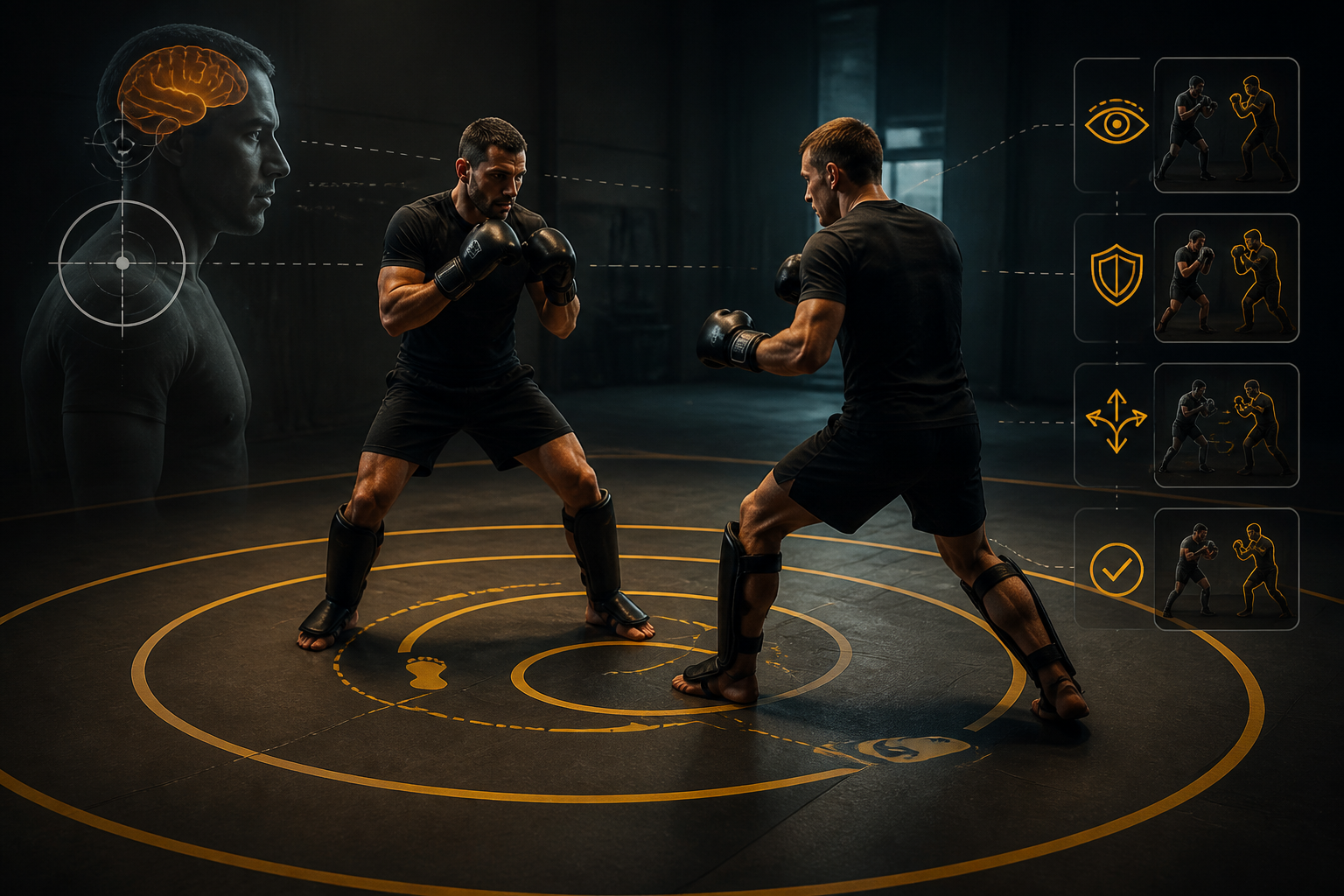
Direct answer: Fighting rhythm is the pattern behind the action: who is setting pace, who is forcing, who is losing options, and when the exchange is about to change. The skill is not just noticing speed. It is noticing the first signs that a fighter’s choices are shrinking so you can reset, adjust, or take initiative before the round turns.
Fighting rhythm is the pace, tension, and decision pattern inside an exchange. Read it well and you see pressure early; miss it and you react late.
Read this first
- Rhythm is not just tempo. It is pace plus pressure plus decision timing.
- The first clue is usually small: breath, feet, eyes, posture, or timing.
- A clean reset is often better than a big correction.
- Good fight IQ means reading what changed before the obvious mistake.
What changes under pressure
Pressure changes what a fighter can see and use. The body may still be moving, but the mind starts sorting for survival, not solutions.
That is why the visible mistake is usually the last step in a longer chain. The real change often starts with narrowed attention, shorter breath, tighter posture, or a bad sense of time.
Look for the state before the mistake, not just the mistake itself.
- Breathing gets shallow or rushed.
- The feet square up or stop adjusting.
- The eyes stop scanning and lock onto one target.
- Exits feel late or blocked even when space is still there.
| Layer | What to check | Better question |
|---|---|---|
| Pressure | First visible change | What shifted before the obvious exchange? |
| Attention | Where the eyes and mind are locked | What stopped being seen? |
| Structure | Feet, posture, frames, exits | Did options expand or shrink? |
| Timing | Beat, pause, initiative | Was the action early, late, or forced? |
| Reset | Smallest useful correction | What would make the next rep cleaner? |
The hidden decision problem
Most fighters do not think, I am making bad choices. The experience feels automatic. They rush, shell, reach, freeze, or overcommit because the exchange has already changed the decision environment.
This is where Fight IQ matters. Better knowledge is not enough. The fighter has to keep enough perception alive to keep choosing from the right menu.
Decision quality often breaks before technique looks broken.
- Panic replaces the original plan.
- The athlete forces action to recover control.
- The fighter waits too long because the moment feels bigger than it is.
- A simple answer is still available, but it no longer feels available.
| State | What it looks like | What it usually needs |
|---|---|---|
| Rushing | Chasing after a miss | Feet, breath, and a small exit |
| Freezing | Shelling up too early | One clear frame or angle |
| Forcing | Overcommitting to win space back | A slower re-entry from structure |
| Drifting | Waiting without reading | A cue that brings attention back to the exchange |
What to notice first
Start with the first signal that the exchange is slipping. That signal is often more useful than the final mistake because it is easier to change.
A strong read is small and specific. You are not trying to solve the whole round at once. You are trying to recover one readable state.
The earlier the cue, the easier the correction.
- A sudden need to force the exchange
- Rushed breathing after a clean exchange
- Eyes fixed on one target too long
- Feet becoming square or planted
- Late exits after contact
| First cue | What it can mean | Simple response |
|---|---|---|
| Breath gets choppy | Stress is rising | Reset with one exhale and re-center |
| Eyes stop scanning | Awareness is narrowing | Look for one exit or angle |
| Feet go flat | Movement quality is dropping | Rebuild base before re-entering |
| Action feels forced | Tempo is no longer yours | Slow down one beat and read again |
A practical way to train it
Use one cue, one reset, and one review question. That keeps the work simple enough to repeat and honest enough to improve.
The cue tells you pressure is rising. The reset gives you a physical answer. The review question teaches you what happened so the next round is cleaner.
Small training loops build clearer reads than big theories do.
- Choose one cue that appears before the mistake.
- Choose one reset you can do live.
- Choose one question for after the round.
- Keep the loop short until it becomes automatic.
| Part of the loop | Example | Purpose |
|---|---|---|
| Cue | Eyes stop scanning | Notice narrowing early |
| Reset | Small exit and breath | Recover options |
| Review | What option disappeared first? | Turn the round into usable data |
How this shows up in real training
The idea gets clearer when you watch live rounds, drilling, or film. You will see the same pattern in different clothes: pressure rises, attention narrows, and the fighter starts losing clean choices.
That is why the useful question is not whether the athlete looked busy. The useful question is whether they still had options.
Activity is not the same as control.
- Chasing after a missed shot usually means the athlete lost the original structure.
- Shelling too early usually means attention has narrowed to survival.
- Feeling rushed often means the timing cue was missed before technique failed.
- A clean read should ask what options were still alive, not just what landed.
| Situation | What it often means | Cleaner next move |
|---|---|---|
| The athlete chases after a miss | Status panic replaced the plan | Reset the feet and re-enter from structure |
| The athlete shells too early | Pressure narrowed attention | Name one exit before adding offense |
| The athlete says they felt rushed | The timing cue came too fast | Slow the drill and find the first beat change |
| The athlete keeps forcing entries | The moment felt lost | Pause, re-center, then take the next opening |
A coachable way to think about it
The best coaching sentence is simple: what changed, what disappeared, and what should happen next. That keeps the talk tied to the round instead of drifting into theory.
If you coach fighters, this gives you something direct to say under stress. If you are the fighter, it gives you a note you can carry into the next rep.
Short coaching language often works better than long explanations.
- What changed before the obvious mistake?
- What option disappeared first?
- What reset would have kept the exchange readable?
| Coaching focus | Good sign | Bad sign |
|---|---|---|
| Read the state | Athlete can name the cue | Athlete only talks about the end result |
| Keep it small | One correction at a time | Three fixes at once |
| Stay usable | Next rep improves | Discussion stays abstract |
A seven-day practice plan
A short practice plan keeps the idea from staying vague. The goal is not mastery in a week. The goal is one better read, then another.
Use the plan with film, sparring, drilling, or even coaching notes.
One small pattern, repeated, becomes real skill.
- Day 1: Watch one round and write the first pressure cue you notice.
- Day 2: Pick one cue that appears before the mistake.
- Day 3: Choose one live reset.
- Day 4: Test the cue and reset in a slow drill.
- Day 5: Compare one moment of clarity and one moment of collapse.
- Day 6: Write one coaching sentence or self-review note.
- Day 7: Decide what deserves deeper work next.
| Day | Task | Result |
|---|---|---|
| 1 | Watch and note the first cue | Build awareness |
| 2 | Pick the cue | Make it specific |
| 3 | Choose the reset | Make it usable |
| 4 | Test in drill | Tie it to action |
| 5 | Compare two moments | Spot the pattern |
| 6 | Write the lesson | Turn it into language |
| 7 | Plan next focus | Keep the learning moving |
Common mistakes and better fixes
Most people do not fail because they do not care. They fail because they try to make the topic too broad, too late, or too abstract.
The fix is usually smaller than they expect.
If the correction is too big, the fighter will not use it under stress.
- Mistake: treating composure like personality. Fix: treat it like a trained response to cues.
- Mistake: waiting until the exchange falls apart. Fix: watch for the first narrowing of attention.
- Mistake: adding complexity when clarity is needed. Fix: simplify the first read.
- Mistake: reviewing only the finish. Fix: review the state before the finish.
| Mistake | Why it fails | Better fix |
|---|---|---|
| Trying to fix everything at once | Too much to remember under pressure | Use one cue, one reset, one review question |
| Confusing intensity with clarity | More effort does not always mean better choices | Ask whether the extra effort improved options |
| Making it only theory | No link to live reps | Attach it to a real round or clip |
| Skipping the follow-up | No learning gets carried forward | Write down what to watch next |
A simple review loop
After a round, write down one moment where the mind changed before the technique changed. Then answer three questions: what stopped being seen, what got forced, and what option was still there.
Keep the loop short. One signal, one reset, one lesson. If the review gets too large, it adds pressure instead of removing it.
Good review turns pressure into usable data.
- What changed first?
- What stopped being seen?
- What did the fighter start forcing?
- What option was still available?
| Review step | Prompt | Value |
|---|---|---|
| Signal | What changed first? | Find the real start |
| Reset | What could have been done live? | Improve the next rep |
| Lesson | What should I watch next time? | Make the learning stick |
What this is not saying
This is not saying mindset fixes everything. Skill, conditioning, matchup, and physical reality still matter.
It is also not saying the answer is to slow down and think harder in the middle of every exchange. The goal is clearer action, not timid action. A calm read can produce a fast response because the fighter is no longer solving three false problems at once.
Better reading should lead to cleaner action, not hesitation.
- Pressure reading does not replace technique.
- Rhythm reading does not erase physical fatigue.
- A calm read can still lead to a fast attack.
- The point is clarity under stress, not passivity.
| What this is not | What it is |
|---|---|
| A magic fix | A better way to read state |
| Passive fighting | Clearer decisions under stress |
| Overthinking | Less confusion in live exchange |
A seven-day practice plan
Use this as a simple way to turn the idea into a week of practice, film study, or coaching notes.
| Step | Action |
|---|---|
| Observe | Watch one round or clip and note the first cue that shows pressure rising. |
| Name | Pick one cue, one reset, and one review question. |
| Test | Use the reset in drilling or light sparring. |
| Review | Write down what changed before the mistake. |
| Refine | Keep the loop small until it works under stress. |
Common mistakes and better fixes
Most mistakes come from reading the moment too late or trying to solve too much at once.
| Mistake | Better fix |
|---|---|
| Treating composure like a personality trait | Train it as a repeatable response to pressure cues. |
| Only studying the final mistake | Look for the first state change that led to it. |
| Using too many corrections | Stick to one cue, one reset, one review question. |
| Confusing activity with control | Ask whether the fighter still had real options. |
Reader checklist
- I can explain fighting rhythm in one plain sentence.
- I can point to the first cue in a real exchange.
- I know one live reset I can use under pressure.
- I can tell the difference between a symptom and the state underneath it.
- I know what to watch for in the next round or clip.
Next Spiral Combat path
If you want the deeper Spiral Combat lens, move next into pressure, geometry, and timing in the Fight IQ library, then connect this read to the Spiral Combat Codex for a fuller system.
Related Spiral Combat reading
FAQ
What is fighting rhythm in plain English?
It is the pattern of pace, pressure, and decision timing inside an exchange. It shows who is setting the tempo and who is losing options.
What should I notice first when pressure rises?
Look for the earliest sign of narrowing: breath, feet, eyes, posture, or timing. The first cue is usually small but useful.
How do I study pressure without overcomplicating it?
Pick one round, one cue, one reset, and one review question. Keep the loop short so you can actually use it in training.
What is the biggest mistake fighters make with rhythm?
They notice the final mistake but miss the state that caused it. By the time the shot, shell, or chase appears, the exchange was already changing.
Key takeaways
- Rhythm is a read on pace, pressure, and decision timing.
- The first useful clue is often small and physical.
- Good fight IQ keeps enough perception alive to make a clean choice.
- A short cue-reset-review loop turns the idea into training data.
- Clearer reading should lead to cleaner action, not hesitation.