
Table of contents
- Read this first
- What martial arts books should do for a fighter
- What changes first under pressure
- The hidden decision problem
- What to notice first in a live exchange
- A practical way to study pressure
- Examples you can use right away
- A coachable way to think about it
- A seven-day practice plan
- Common mistakes and better fixes
- How this shows up before the obvious mistake
- Reader checklist
Direct answer: Martial arts books help when they teach you to read pressure, spot the first breakdown, and make one better choice before the moment gets messy. They are most useful when you can turn what you read into a cue, a reset, and a simple review after training or film study.
The best martial arts books do not just add facts. They help you see pressure earlier, keep your structure longer, and make cleaner decisions when the exchange starts to tighten.
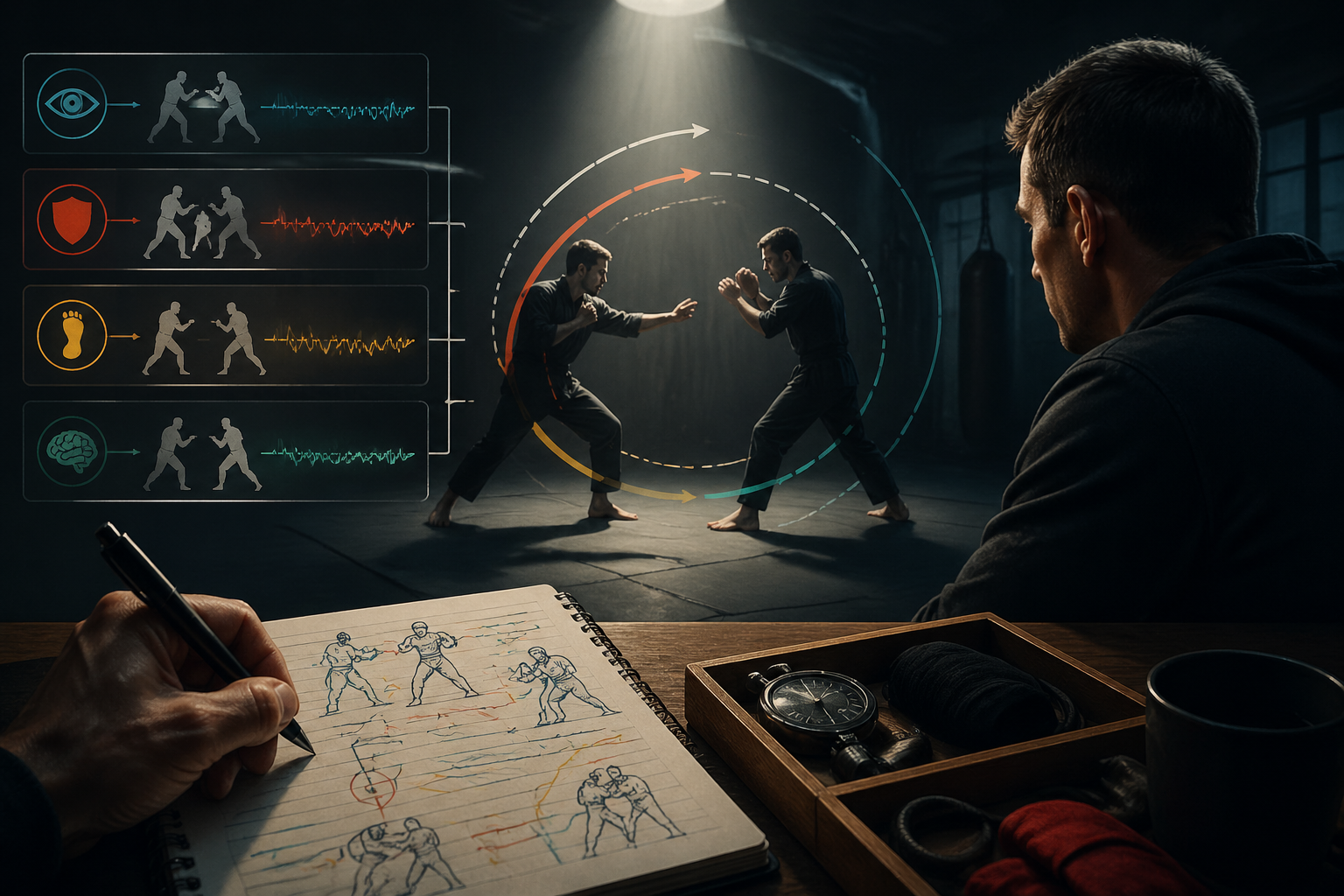
Read this first
- Not every martial arts book is useful for live fighting. Some are good history, some are good theory, and some are only useful if you already know the context.
- The real test is simple: does the book improve what you notice, what you do under stress, or how you review your rounds?
- A strong reader does not chase more information. They build a sharper eye for pressure, timing, posture, breath, and decision quality.
- In Spiral Combat, books are part of Fight IQ. They matter because they can sharpen perception, not just fill memory.
What martial arts books should do for a fighter
A good martial arts book should make your training clearer, not louder. It should help you notice what changes first when pressure rises, what stays available, and what gets lost if you wait too long.
The value is not in collecting opinions. The value is in learning to spot patterns that matter in sparring, drilling, coaching, and fight study. If a book does not change what you can see, it will not change what you can do.
This is why the best books are the ones that improve reading. They help you see when someone is losing structure, rushing their entries, or forcing a plan that no longer fits the moment.
A useful martial arts book improves your eye before it improves your vocabulary.
- Look for clear ideas about pressure, timing, distance, and structure.
- Prefer books that give you concepts you can test in training.
- Use books to sharpen review, not to replace reps.
- Treat theory as a tool for better action, not as a substitute for action.
| What the book teaches | Why it matters | What to do with it |
|---|---|---|
| Pressure and stress | Shows how decisions change when the round gets tense | Watch for the first sign of narrowing attention |
| Timing and rhythm | Explains when initiative changes hands | Compare early, late, and forced actions in footage |
| Structure and posture | Keeps the body readable under stress | Check feet, frames, exits, and balance |
| Decision making | Links thought to action | Ask what option disappeared first |
What changes first under pressure
Pressure usually changes the mind before it changes the result. The fighter may still look active, but attention has already narrowed. Breath gets shorter. The eyes stop scanning. Feet square up. The body starts solving the wrong problem.
That is why the first visible mistake is often not the real mistake. The real mistake happened earlier, when perception got tight and the athlete lost a clean read on the exchange.
When you study martial arts books through this lens, you stop asking only what technique was used. You start asking what state produced it.
The first problem is often not bad technique. It is a bad read.
- Narrowed eyes usually mean narrowed options.
- Rushed breath often shows stress before panic becomes obvious.
- Square feet can be a sign that the fighter is preparing to force the exchange.
- Late exits often mean the athlete has already lost a clean picture.
| Pressure clue | What it may mean | Better response |
|---|---|---|
| Breath gets shallow | Stress is rising | Slow down the moment with one clean reset |
| Eyes lock on one target | Scanning has dropped | Recover awareness of exits, angles, and space |
| Feet get square | Structure is slipping | Rebuild the base before re-entering |
| Action feels forced | Timing has gone | Return to a simpler entry or exit |
The hidden decision problem
Most fighters do not feel like they are choosing badly. They feel like the exchange got away from them. That is the hidden decision problem. The environment changed faster than their best option did.
A fighter may chase, shell early, freeze, or overcommit because the pressure has already changed what feels possible. The body is still acting, but the menu has shrunk.
This is where martial arts books can help Fight IQ. A strong book can teach you to look past the obvious error and ask what changed in perception, timing, or emotional load before the error showed up.
Better decisions start with better perception.
- Do not stop at the visible mistake.
- Ask what the fighter stopped seeing.
- Ask what they started forcing.
- Ask what option was still there but no longer felt available.
| Visible mistake | Possible hidden state | Coach's first question |
|---|---|---|
| Chasing after a miss | Panic or status pressure | What did the fighter think they had to recover? |
| Early shelling | Fear of damage or loss of space | What exit or frame did they stop using? |
| Freezing | Overload or uncertainty | What did they fail to read fast enough? |
| Forcing attacks | Need to win the moment back | What simpler action was available first? |
What to notice first in a live exchange
Start with the first readable cue, not the final failure. Look for the moment the fighter’s structure, breath, or awareness begins to tighten. That is usually easier to coach than the full mistake that comes later.
A first cue might be a rushed entry, a locked gaze, a delayed exit, or a small collapse in posture. None of these tells the whole story, but each one gives you a better place to begin.
The goal is not to diagnose everything in real time. The goal is to catch the first change early enough that one clean adjustment is still possible.
Do not wait for the mess. Catch the first narrowing.
- Watch for breath changes before you watch for the finish.
- Watch for posture changes before you watch for the takedown or strike.
- Watch for eye behavior before you watch for the outcome.
- Watch for the loss of exits before you watch for the loss of position.
| First cue | Why it matters | Simple correction |
|---|---|---|
| Rushed breath | Shows stress is rising | Reset with one calm breath and re-check space |
| Locked eyes | Shows scanning has dropped | Recover the habit of looking for angles and exits |
| Square stance | Shows readiness to force instead of flow | Rebuild the base before the next entry |
| Late recovery | Shows timing has slipped | Pause one beat and re-enter cleaner |
A practical way to study pressure
Use three things: one cue, one reset, and one review question. That keeps the work simple enough to use in real training.
The cue tells you pressure is rising. The reset gives you a physical action that brings back structure. The review question teaches you what to look for next time.
This is a better method than trying to remember ten concepts at once. Under stress, fighters do not need more theory. They need a repeatable path back to clarity.
One cue. One reset. One honest review.
- Cue: notice the first sign that attention is narrowing.
- Reset: use a small action that restores posture, breath, or distance.
- Review question: what disappeared first?
| Part | Purpose | Example |
|---|---|---|
| Cue | Shows pressure is rising | Eyes stop scanning |
| Reset | Restores structure | One breath plus one small exit |
| Review question | Turns the round into data | What option disappeared first? |
Examples you can use right away
Examples matter because the idea only becomes real when you can spot it in practice. Use these as starting points and then swap in your own rounds, clips, or coaching notes.
If a fighter chases after a miss, the issue may be status pressure. If they shell too early, the issue may be a narrowed field of view. If they keep saying they felt rushed, the issue may be timing collapse before technique failure.
The cleaner next move is usually smaller than the athlete expects. Reset the feet, recover the breath, re-open the eyes, and enter again from a better read.
The next move is often smaller than the emotion around it.
- Chasing after a miss usually means the fighter wants the moment back fast.
- Early shelling often means the fighter has stopped reading exits.
- Feeling rushed often means the fighter lost the beat before losing the skill.
- A small reset often creates a better second decision.
| Situation | What it often means | Cleaner next move |
|---|---|---|
| Chasing after a miss | Panic or status pressure | Reset the feet, breathe, and re-enter from structure |
| Shelling too early | Attention has narrowed to survival | Name one exit or frame before adding offense |
| Feeling rushed | Timing has collapsed | Slow the rep and find the first timing cue |
| Forcing the action | The fighter is trying to win back control | Return to a simpler entry or angle |
A coachable way to think about it
The useful question is not whether you understood the chapter. The useful question is what the chapter helps you notice sooner in a live round.
That question turns books into training tools. It also makes coaching easier. A coach can point to one pressure cue, one structural loss, and one better next step without turning the whole round into a lecture.
This is the kind of thinking Spiral Combat tries to protect: pressure, geometry, timing, and decision quality in the same frame.
If the book does not change what you notice, it is still just information.
- Ask what the book helps you see earlier.
- Ask what it helps you say more clearly after the round.
- Ask what it helps you train more honestly.
- Ask whether it gives you one useful sentence you can carry into the next session.
| Coach question | Why it helps | What it leads to |
|---|---|---|
| What changed first? | Finds the real start of the problem | Better feedback |
| What disappeared? | Shows the lost option | Cleaner adjustment |
| What stayed available? | Prevents overreacting | Smaller correction |
| What should happen next? | Connects reading to action | A usable rep |
A seven-day practice plan
Keep the first week simple. The point is not mastery. The point is to build one honest loop between reading, training, and review.
Use a clip, a round, or even a short coaching note. Do not try to solve your whole game. Just train the habit of seeing pressure earlier and naming it clearly.
If you can do that for seven days, the topic stops being abstract. It starts becoming part of your eye.
Small daily reps beat one big theory session.
- Day 1: Watch one round and write the first pressure cue you notice.
- Day 2: Pick one cue that appears before the mistake.
- Day 3: Choose one reset you can use live.
- Day 4: Test the cue and reset in a controlled drill.
- Day 5: Compare one clean moment and one collapsing moment.
- Day 6: Write one short coaching note in plain English.
- Day 7: Decide what lesson or drill should come next.
| Day | Focus | Output |
|---|---|---|
| 1 | Notice | One pressure cue |
| 2 | Select | One reliable signal |
| 3 | Reset | One physical correction |
| 4 | Test | One live drill or slow rep |
| 5 | Compare | One clear before/after read |
| 6 | Write | One coaching sentence |
| 7 | Review | One next step |
Common mistakes and better fixes
Most people do not fail because they are lazy. They fail because the idea stays too broad. A broad idea is hard to use under pressure.
The fix is usually smaller language, cleaner review, and a tighter link between the book and a real rep. If you cannot use the idea in training, you do not own it yet.
That does not mean the book is bad. It means the reader still needs a better bridge from page to round.
If the idea stays vague, it will not survive stress.
- Do not try to fix everything at once.
- Do not confuse intensity with clarity.
- Do not leave the idea in theory only.
- Do not skip the review after the rep.
| Mistake | Better fix |
|---|---|
| Trying to fix everything at once | Use one cue, one reset, one review question |
| Confusing effort with clarity | Ask whether the action created better options |
| Keeping it theoretical | Attach it to a real round or clip |
| Skipping review | Write down what changed first and what was still available |
How this shows up before the obvious mistake
The obvious mistake usually comes late. By the time a fighter rushes, freezes, chases, or gives up position, the pressure pattern has already been building for a while.
The earlier read is often quieter. It might be a first breath change, a loss of scanning, or a moment where the fighter stops seeing exits. Those details are easy to miss and very useful to catch.
This is where good martial arts books can help the most. They train the reader to separate the symptom from the state underneath it.
A bad shot is often the symptom. The state came first.
- Look for the first narrowing of attention.
- Look for the first rushed breath.
- Look for the first moment the fighter stops seeing exits.
- Look for the state before the visible error.
| What you see | What may be underneath | Why the distinction matters |
|---|---|---|
| Bad shot or entry | Panic, fatigue, or overcommitment | Different states need different corrections |
| Late defense | Narrowed awareness | The fix may be awareness, not more speed |
| Forced attack | Need to regain control | The fix may be patience, not more aggression |
| Frozen response | Overload or uncertainty | The fix may be a simpler target or reset |
Reader checklist
- Can I explain the main idea in one plain sentence?
- Can I name the first pressure cue in a real exchange?
- Do I know what the cleaner reset looks like?
- Did I connect the book to an actual rep, clip, or coaching note?
- Can I say what changed before the visible mistake?
- Do I know what to watch for next time?
Next Spiral Combat path
If you want the deeper system behind this idea, move next into Spiral Combat Codex material on pressure, geometry, timing, and decision quality.
Related Spiral Combat reading
FAQ
What is the best way to study martial arts books for fight IQ?
Read with one live question in mind: what does this help me notice earlier in a real exchange? Then test that idea against a round, a clip, or a drill. The book is doing its job only if it changes what you can read under pressure.
What should I look for first when pressure rises?
Look for the first visible narrowing: breath, eyes, feet, posture, or exits. The exact cue depends on the fighter, but the goal is the same. Catch the state before the obvious mistake.
How do I make a book useful instead of just interesting?
Turn it into a small loop. Pick one cue, one reset, and one review question. If you cannot connect the idea to a round or drill, it is still theory.
Do all martial arts books help in the same way?
No. Some books are better for history, some for concepts, and some for coaching language. The useful ones for fighters are the ones that improve reading, timing, structure, and decision making.
Key takeaways
- Martial arts books help most when they sharpen perception under pressure.
- The first real problem is often a change in attention, breath, or structure.
- One cue, one reset, and one review question is enough to start.
- The goal is not more information. The goal is better action in real time.
- Spiral Combat treats books as part of Fight IQ, not as isolated reading.