
Table of contents
- Read this first
- What cage control really changes
- The hidden decision problem
- What to notice first
- How to train cage control without overcomplicating it
- Examples you can use right away
- A coachable way to think about it
- A seven-day practice plan
- Common mistakes
- How this shows up before the obvious mistake
- A simple review loop
- A seven-day practice plan
- Common mistakes and better fixes
- Reader checklist
Direct answer: MMA cage control is useful when you can spot the first visible cue, keep your structure intact, and make a simple reset before the exchange turns into a scramble. The real skill is not only moving someone toward the fence. It is recognizing how pressure changes breathing, posture, attention, and decision speed.
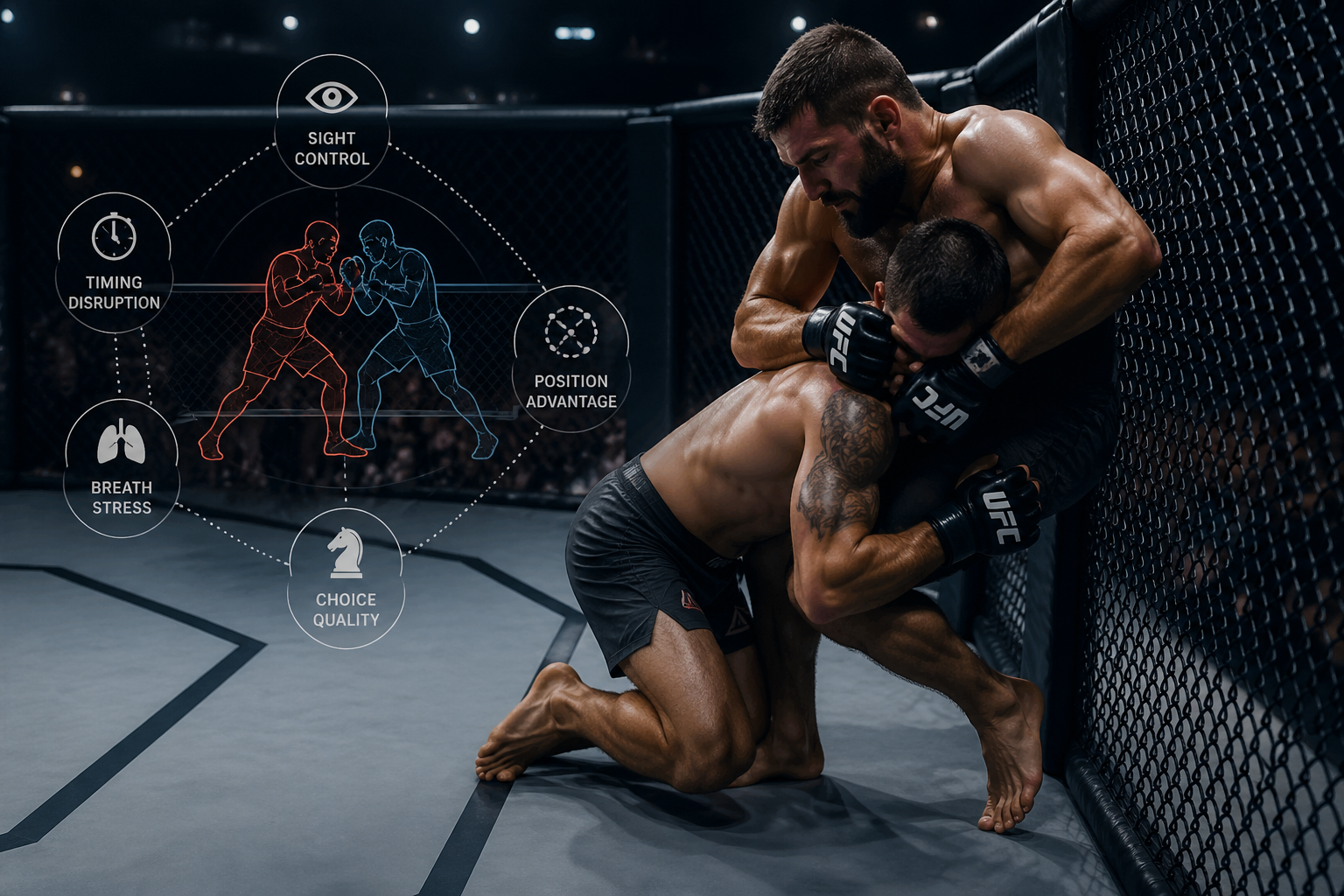
Cage control is not just about pushing someone backward. It is about reading when pressure changes the fight, noticing what options disappear, and choosing the next clean move before the exchange gets messy.
Read this first
- Pressure usually changes the mind before it changes the position.
- The first bad read is often small: a rushed breath, square feet, or a narrowed view.
- Good cage control is about geometry, timing, and perception, not just strength.
- A useful reset is small enough to do live: a step, frame, breath, angle, or exit.
- The best review question is simple: what disappeared first?
What cage control really changes
Cage control changes the fight by changing space, time, and options. Once a fighter’s back nears the fence, the room to escape, pivot, or reset shrinks fast. That does not only affect movement. It affects judgment.
A fighter under pressure may still look active, but the real question is whether they still see clean exits. When the fence starts shaping choices, every exchange carries more risk. That is why cage control belongs in Fight IQ, not just in footwork drills.
The fence does more than stop movement. It changes what the fighter believes is available.
- Less space to recover position
- Less time to read the next attack
- More pressure on breathing and posture
- More chance of forced reactions instead of chosen ones
| Layer | What to check | What it tells you |
|---|---|---|
| Space | Can the fighter still angle out or pivot? | Options are still alive or already shrinking. |
| Posture | Are the hips, head, and feet aligned? | The fighter can defend and move, or is starting to collapse. |
| Attention | Is the fighter still scanning or staring? | The mind is still flexible, or already trapped on one problem. |
| Timing | Who is forcing the beat? | The exchange is being chosen, or merely survived. |
| Reset | What small action restores clarity? | The next move is recoverable, or the round is spiraling. |
The hidden decision problem
Most fighters do not feel themselves making a bad decision. They feel rushed, crowded, or late. That is the real problem. Pressure changes the decision environment before the visible mistake shows up.
A person can still be throwing punches, pummeling, or circling and already be losing the fight inside the exchange. The body keeps working, but the mind has fewer clean choices. Cage control matters because it exposes that loss early.
Bad decisions under pressure often look like speed. Sometimes they are really confusion.
- Chasing after missing one shot
- Shelling up before the threat is real
- Forcing offense instead of reloading position
- Waiting too long because the next move feels larger than it is
| What changed | What it often means | Better read |
|---|---|---|
| Breathing got shorter | Stress is rising | Pause long enough to recover one clean breath. |
| Feet got square | The body is losing angle | Rebuild stance before adding offense. |
| Eyes locked on one target | Attention has narrowed | Scan for the exit, frame, or angle first. |
| Action feels forced | Timing is gone | Take back the beat instead of forcing a finish. |
What to notice first
Start with the first cue that shows pressure is working. Do not wait for the obvious mistake. By then the real lesson is usually already over.
The strongest first cues are simple and physical: rushed breathing, square feet, late exits, a frozen gaze, or a sudden urge to force contact. Once you can see that cue, the correction gets smaller and more honest.
Do not chase the final mistake. Find the first readable signal.
- Breath shortens before technique breaks
- Feet flatten before movement disappears
- Eyes stop scanning before the cage feels small
- The urge to force action often appears before panic becomes obvious
| Cue | What it can mean | Coachable response |
|---|---|---|
| Rushed breath | Stress is climbing | Call for one breath and one step. |
| Square stance | The fighter is losing angle | Rebuild feet before re-entering. |
| Locked eyes | Attention has narrowed | Ask the fighter to scan for space. |
| Forced entry | The beat has been lost | Reset the rhythm before trying again. |
How to train cage control without overcomplicating it
Use one cue, one reset, and one review question. That keeps the lesson usable. The cue tells you pressure is rising. The reset gives you a live action that restores balance. The review question tells you what to study after the round.
This is how the topic stays practical. You are not trying to solve every problem at once. You are building a repeatable way to notice pressure earlier and respond with less noise.
Keep the loop small: notice, reset, review.
- Choose one pressure cue you can see in real time
- Pick one reset you can do under fire
- Ask one review question after the round
- Repeat until the read becomes faster and cleaner
| Part of the loop | Example | Why it helps |
|---|---|---|
| Cue | Eyes stop scanning | Shows pressure before the mistake grows. |
| Reset | Small exit with a breath | Restores space and decision quality. |
| Review question | What option disappeared first? | Turns the round into useful feedback. |
Examples you can use right away
Examples matter because cage control looks different in each room: sparring, drilling, live grappling, or a fight review. The point is not to memorize every version. The point is to recognize the pattern.
Use these examples as a starting point, then map them to your own rounds and clips.
The same pressure can show up as hesitation, panic, or overcommitment.
- If the athlete rushes forward after missing, the problem may be lost structure and a need to win the moment back.
- If the athlete shells too early, the problem may be narrowed attention and fear of the next contact.
- If the athlete keeps circling but never re-enters cleanly, the problem may be timing, not effort.
- If the athlete says they felt crowded, the body may have lost angle before the mind noticed it.
| Situation | What it usually means | Cleaner next move |
|---|---|---|
| Chasing after a miss | Status panic replaced the plan | Reset the feet, breathe, re-enter from structure. |
| Shelling before contact | Attention narrowed too soon | Name one exit or frame before adding offense. |
| Feeling rushed | The beat collapsed | Slow the exchange enough to see the first cue. |
| Staying busy but trapped | Movement lost meaning | Look for angle, not just motion. |
A coachable way to think about it
A coach does not need a dramatic speech here. A short, useful sentence works better. The point is to make the next read clearer than the last one.
A good coaching question is not, “Do you understand cage control?” It is, “What did pressure make you stop seeing?” That question points to the real problem: perception under stress.
Better questions create better rounds.
- What changed first?
- What option disappeared?
- What reset would have helped sooner?
- Did the athlete lose space, rhythm, or attention first?
| Question | What it reveals | Why it matters |
|---|---|---|
| What changed first? | The first visible cue | Helps separate cause from symptom. |
| What disappeared? | The lost option | Shows what the fighter could not access. |
| What reset was possible? | The next clean action | Keeps the correction realistic. |
A seven-day practice plan
This plan keeps the work small enough to actually do. One short pass each day is enough. The goal is not perfect mastery. The goal is better recognition.
Use film, sparring notes, or a live round. Any honest example will do.
Small practice beats vague intention.
- Day 1: Watch one round and name the first pressure cue you notice.
- Day 2: Pick one cue that appears before the obvious mistake.
- Day 3: Choose one reset that works while the round is still live.
- Day 4: Test the cue and reset in a slow drill or technical round.
- Day 5: Compare one moment of clear space with one moment of collapse.
- Day 6: Write one short coaching note from the pattern.
- Day 7: Decide what deeper topic should follow: entries, exits, fence defense, or pressure reads.
| Day | Action | Focus |
|---|---|---|
| 1 | Watch and note the first cue | See pressure earlier |
| 2 | Choose one pre-mistake signal | Remove guesswork |
| 3 | Pick one live reset | Make the response usable |
| 4 | Test in a drill | Link idea to action |
| 5 | Compare two moments | Find the pattern |
| 6 | Write a coaching note | Turn insight into language |
| 7 | Choose the next study path | Keep the learning moving |
Common mistakes
Most errors here come from making the idea too broad or too late. If the explanation waits until the end of the exchange, it has already missed the lesson.
Another mistake is treating composure like personality. Composure is usually built from repeatable cues, sound spacing, and honest review.
Pressure work should make the next rep cleaner, not more complicated.
- Watching only the final mistake instead of the first signal
- Confusing intensity with clarity
- Trying to fix everything in one sentence
- Using theory without tying it to a round or clip
| Mistake | Why it fails | Better fix |
|---|---|---|
| Fixing everything at once | The athlete has too many tasks | Use one cue, one reset, one review question. |
| Calling it mindset only | The body and space still matter | Study posture, feet, and exits too. |
| Talking in abstractions | The lesson stays far away | Attach it to one real exchange. |
How this shows up before the obvious mistake
The visible mistake is usually late. By the time the fighter chases, freezes, rushes, or gives up position, the pressure pattern has been building for seconds.
That is why the better read is earlier and simpler. Look for the first narrowing of attention, the first rushed breath, or the first moment the fighter stops seeing exits. Those signals tell you more than the final scramble does.
Different pressure states need different fixes. Fatigue, panic, embarrassment, and overcommitment may all look like bad cage control on the surface, but they do not always need the same correction. A coach who can name the state can give a smaller, better response.
The first readable change is often the most valuable one.
- Narrow attention before panic
- Rushed breath before bad technique
- Square feet before lost movement
- Forced action before a full breakdown
| Before the mistake | What to look for | Why it matters |
|---|---|---|
| Attention narrows | The fighter stops scanning | This is where options start disappearing. |
| Breath gets short | Stress is rising | The body is losing calm and timing. |
| Feet square up | Angle is fading | Movement and defense get weaker. |
| Action feels forced | The beat is gone | The fighter is reacting, not choosing. |
A simple review loop
After the round, write down one moment where the mind changed before the technique changed. Keep the note short. One signal, one reset, one lesson.
Ask three questions: What did the fighter stop seeing? What did they start forcing? What option was still there but no longer felt available? This turns a hard round into training data.
Over time, the athlete builds a personal pressure map. They learn which states make them chase, which states make them wait, and which states make them abandon structure.
Short reviews create better recall than long speeches.
- Name the first signal
- Name the reset that should have happened
- Name the option that disappeared
- Save the lesson for the next round
| Review question | What it teaches |
|---|---|
| What stopped being visible? | How pressure affected perception. |
| What got forced? | How the fighter lost timing. |
| What was still available? | How to recover next time. |
A seven-day practice plan
Use this as a simple way to turn the idea into a week of practice, film study, or coaching notes.
| Step | Action |
|---|---|
| Day 1 | Watch one round or clip and write down the first pressure cue you notice. |
| Day 2 | Pick one cue that appears before the obvious mistake. |
| Day 3 | Choose one reset that works while the round is still live. |
| Day 4 | Test the cue and reset in a slow drill or technical sparring round. |
| Day 5 | Compare one moment of clear space with one moment of collapse. |
| Day 6 | Write one short coaching note from the pattern. |
| Day 7 | Choose the next topic to study: entries, exits, fence defense, or pressure reads. |
Common mistakes and better fixes
Most mistakes come from reading the moment too late or trying to solve too much at once.
| Mistake | Better fix |
|---|---|
| Watching only the final mistake | Trace the first signal that happened before the error got obvious. |
| Treating composure like personality | Train repeatable cues, sound spacing, and a simple reset. |
| Confusing movement with progress | Check whether the movement creates angle, space, or timing. |
| Making the correction too big | Use one cue, one reset, and one review question. |
Reader checklist
- Can I explain cage control in one plain sentence?
- Can I point to the first visible signal in a real exchange?
- Do I know what a better reset looks like?
- Did I learn something I can use in sparring or film study?
- Can I tell the difference between the symptom and the state?
Next Spiral Combat path
Next, study fence exits and angle changes so you can connect pressure reads to cleaner movement off the cage.
Related Spiral Combat reading
FAQ
What is MMA cage control?
It is the skill of using the fence, space, timing, and pressure to shape what choices are available in the exchange.
Why does the fence change the fight so much?
Because it limits escape routes, compresses time, and makes posture and attention more important.
What should I look for first when pressure builds?
Look for the first readable signal: breathing, feet, eyes, or a forced reaction.
How should I study pressure in training?
Use one cue, one reset, and one review question, then compare the round to what you expected.
Is cage control only about pushing someone backward?
No. Good cage control is about forcing decisions, managing space, and staying ready for the next move.
Key takeaways
- Cage control is about shaping decisions, not just location.
- The first visible cue matters more than the final mistake.
- A small reset is often enough to restore structure and clarity.
- Film study and sparring both improve when you ask what disappeared first.
- Fight IQ grows when you can separate the symptom from the state.