
Table of contents
- Read this first
- What pressure changes first
- The hidden decision problem
- What to notice first
- A simple way to train it
- Examples you can use right away
- The quick decision framework
- A coachable way to think about it
- A seven-day practice plan
- Common mistakes and better fixes
- What this is not saying
- Reader checklist
Direct answer: Calm fighters spot openings earlier because they stay readable under pressure. They notice the first change in breath, posture, feet, or attention, recover their structure fast, and make a smaller decision before the exchange turns messy.
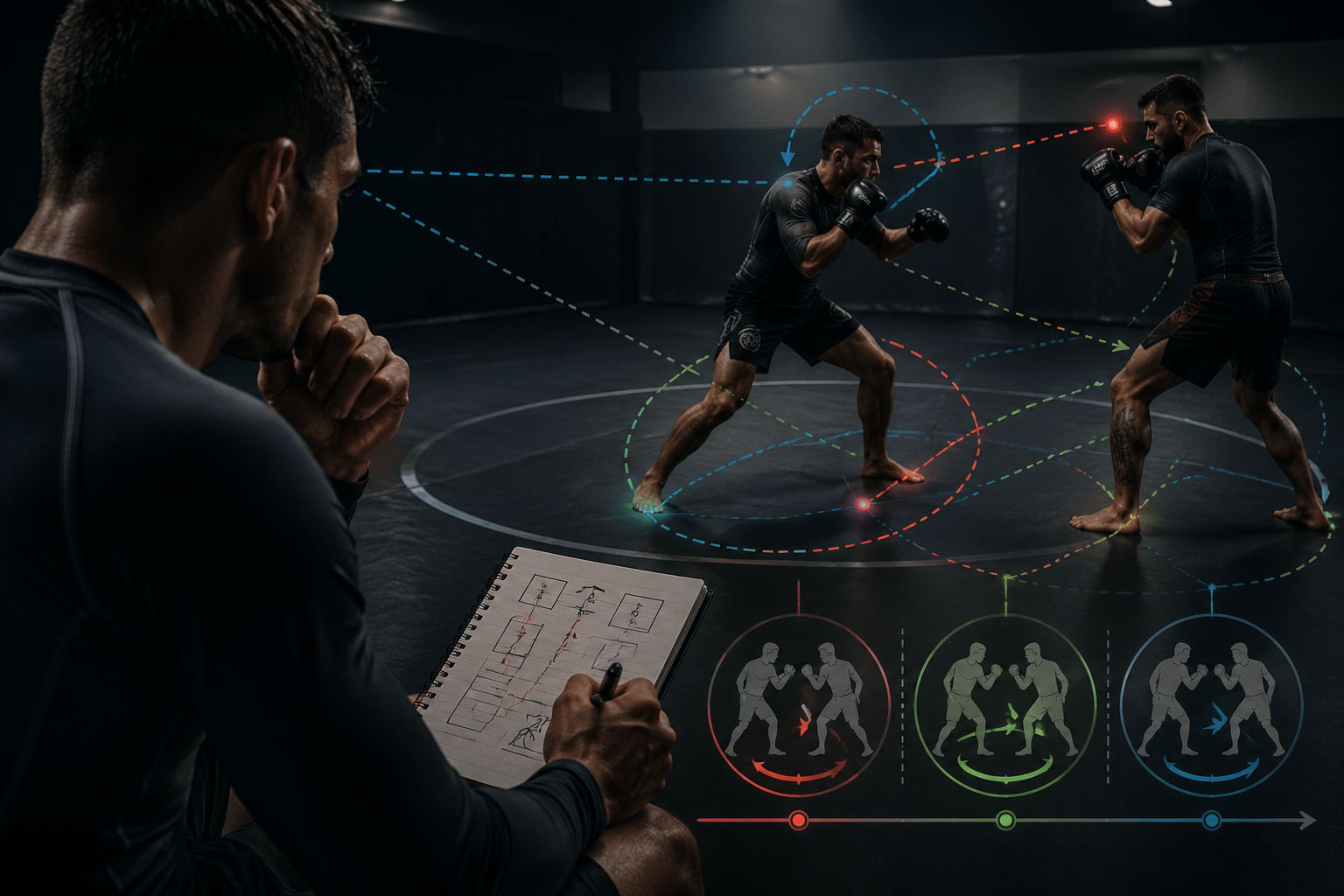
Calm fighters do not see more than everyone else. They keep enough attention, structure, and timing online to notice the opening before stress closes the window.
Read this first
- The first mistake under pressure is often a change in attention, not technique.
- A calm read is not passive. It helps the fighter choose faster and cleaner.
- You can train this with one cue, one reset, and one review question.
- The goal is not perfect composure. The goal is usable clarity in live exchanges.
What pressure changes first
Pressure usually changes what a fighter notices before it changes what the fighter can do. Breathing gets shorter. The eyes lock onto one threat. The feet get square. The mind starts talking faster than the body can solve the moment.
That is why the visible mistake is often late. The bad shot, rushed entry, frozen guard, or wild chase is usually the end of a longer chain. The real problem started when the fighter stopped seeing the whole space.
Spiral Combat looks at that chain because fight IQ is not just knowing more. It is keeping enough perception online to make a better choice while the body is still under stress.
Pressure narrows the map first. Technique usually fails after that.
- Watch for rushed breath.
- Watch for eyes that stop scanning.
- Watch for square feet or stiff exits.
- Watch for the need to force the exchange.
| What changes | What it looks like | Why it matters |
|---|---|---|
| Attention | Eyes lock on one target | The fighter stops seeing exits and frames |
| Breath | Short, shallow, rushed | Timing and patience shrink with it |
| Posture | Feet square, stance gets heavy | Options disappear even before contact |
| Decision speed | Hurry or hesitation | The next action gets forced or delayed |
The hidden decision problem
Most fighters do not feel like they are making bad decisions. The moment feels automatic. They chase, shell up, overcommit, or wait too long because the pressure already changed the decision environment.
That is the hidden problem. The body may still be active, but the menu of options has already shrunk. A fighter can look busy while losing access to the move that would actually fix the exchange.
This is where calmer fighters get ahead. They keep enough awareness to notice the change early, before the round turns into pure reaction.
Better fight IQ means noticing the state before it becomes a mistake.
- Less panic means more options stay visible.
- Less internal noise means timing stays clearer.
- Less rushing means the next reset is still available.
| State change | What disappears | What the fighter usually does |
|---|---|---|
| Narrow attention | Angles and exits | Forces straight-line offense |
| Rising panic | Patience and reads | Chases or overcommits |
| Late timing | Clean initiative | Arrives after the window closes |
| Embarrassment or frustration | Simple solutions | Tries to win the moment back immediately |
What to notice first
Start with the first visible cue that the exchange is getting harder to read. That may be breath, square feet, fixed eyes, a rushed entry, or a sudden need to do something now.
Do not try to fix everything at once. Fixing the whole round is too big. Recovering one readable state is small enough to use live.
The best early cue is the one that shows up before the obvious mistake. If you wait for the bad shot or the bad shell, you are already late.
Look for the first narrowing, not the last collapse.
- Breathing gets tight.
- Feet stop adjusting.
- The eyes stop scanning.
- The fighter stops feeling space and starts forcing contact.
| Early cue | What it may mean | Clean response |
|---|---|---|
| Eyes stop scanning | Attention has narrowed | Look back across the space before firing |
| Breath speeds up | Stress is rising | Take one small reset breath and re-set posture |
| Feet go square | Structure is fading | Rebuild stance and angle before re-entering |
| Attack feels forced | Timing has slipped | Pause one beat and re-enter from better structure |
A simple way to train it
Use one cue, one reset, and one review question. That keeps the idea concrete enough to train instead of admire.
The cue tells you pressure is rising. The reset gives you a physical action that restores structure. The review question tells you what changed first, so the lesson is honest.
This works in sparring, drilling, film study, and coaching feedback. Keep it small enough that you can repeat it next session.
Simple beats clever when stress is high.
- Cue: notice the first sign of narrowing.
- Reset: take a breath, move your feet, or reframe the angle.
- Review: what did I stop seeing first?
| Part | Purpose | Example |
|---|---|---|
| Cue | Catch pressure early | Eyes stop scanning |
| Reset | Recover usable structure | Small exit and breath |
| Review | Turn the rep into data | What option disappeared first? |
Examples you can use right away
Concrete examples make the idea easier to see in real training. Do not look for a perfect match. Look for the pattern.
The point is not to label every bad exchange. The point is to notice what changed before the mistake became visible.
A calm fighter does not guess better. They read earlier.
- If the athlete chases after missing, frustration may have replaced structure.
- If the athlete shells up too early, attention may have narrowed to survival.
- If the athlete says they felt rushed, timing may have collapsed before the technique failed.
| Situation | What it may mean | Cleaner next move |
|---|---|---|
| Chasing after a miss | Status panic replaced the plan | Reset feet, breathe, then re-enter from structure |
| Shelling up too early | The fighter has stopped seeing options | Name one exit or frame before adding offense |
| Feeling rushed | The timing cue was lost | Slow the drill and find the first beat change |
The quick decision framework
When the topic starts to feel abstract, use this simple frame: what changed, what disappeared, and what should happen next.
That is enough for live training and enough for film review. It keeps the mind on the state, not on a vague story about being calm.
Spiral Combat uses this kind of framework because good content should give the reader a tool they can reuse, not just a neat idea to remember.
State first. Technique second. Next move third.
- What changed in breath, feet, eyes, or rhythm?
- What option got harder to see?
- What is the smallest clean reset available now?
| Layer | What to check | Useful question |
|---|---|---|
| Pressure signal | First visible change | What changed before the obvious mistake? |
| Structure | Feet, posture, exits | Did the fighter gain options or lose them? |
| Attention | Where the mind locked on | What did pressure make them stop seeing? |
| Timing | Who owned the beat | Was the action early, late, or forced? |
| Reset | Smallest return to clarity | What would make the next rep cleaner? |
A coachable way to think about it
A coach does not always need a bigger correction. Often the better move is a smaller, cleaner one.
Instead of saying, “Fix everything,” the coach can name the first signal and ask for one reset. That gives the athlete something usable in the next exchange.
This is also a better way to review your own rounds. One signal, one adjustment, one lesson. That is enough to build a pressure map over time.
Small corrections stick better than broad speeches.
- Name the first signal.
- Ask for one reset.
- Review one lesson after the round.
| Coach or athlete note | Why it helps | Example |
|---|---|---|
| Name the signal | Keeps the focus early | Your breath got short before the entry |
| Ask for one reset | Makes the next action possible | Take a step out and re-angle |
| Review one lesson | Builds usable memory | You stopped seeing the exit on the left |
A seven-day practice plan
Do not try to master the whole topic in one sitting. Build the habit in small pieces.
This week-long plan gives the idea a place in training, film review, and self-coaching.
Small daily reps teach the eye to catch pressure sooner.
- Keep each day short.
- Write down only one useful note.
- Use a real round or clip when possible.
| Day | Action | Goal |
|---|---|---|
| Day 1 | Watch one round or clip and note the first pressure cue | Train your eye to spot the start |
| Day 2 | Pick one cue that appears before the mistake | Make the read more specific |
| Day 3 | Choose one reset you can use live | Give the body a clear action |
| Day 4 | Test the cue and reset in a slow drill | Link the read to movement |
| Day 5 | Compare one clear exchange and one bad one | See what disappeared first |
| Day 6 | Write one coaching sentence from the pattern | Turn the lesson into language |
| Day 7 | Decide what deserves deeper study next | Find the next useful step |
Common mistakes and better fixes
Most people do not fail because they lack effort. They fail because the idea stays too broad or too late.
Good fixes are simple, direct, and tied to the next rep.
If the fix is vague, the stress will erase it.
- Mistake: treating composure as personality. Fix: treat it as a trainable skill.
- Mistake: waiting for the obvious error. Fix: look for the first narrowing of attention.
- Mistake: adding more complexity under stress. Fix: use a cleaner first read.
- Mistake: turning the lesson into theory. Fix: attach it to a round, clip, or drill.
| Mistake | Why it fails | Better fix |
|---|---|---|
| Thinking calm is just temperament | It hides the skill inside the personality | Train cue, reset, review |
| Watching only the final error | You arrive too late to learn much | Study the first change in the state |
| Overcomplicating the correction | Stress strips away long instructions | Use one simple response |
| Skipping review | The lesson never becomes repeatable | Write one note after the round |
What this is not saying
This is not a promise that mindset fixes everything. Skill, conditioning, coaching, matchup quality, and physical reality still matter.
It is also not a call to become passive. Calm does not mean slow. Calm means the fighter can act without drowning in noise.
The point is clearer action under pressure. That is the Spiral Combat lens: make the state readable so the next move gets cleaner.
Calm is a combat skill, not a personality trait.
- Not every problem is mental.
- Not every calm fighter is passive.
- Not every fast action is a good action.
| Misread | Better reading | Why it matters |
|---|---|---|
| Calm equals weak | Calm can support sharper choices | The fighter still acts, but with clearer timing |
| Intensity equals readiness | Intensity can hide poor reading | More effort does not always mean more control |
| The last mistake is the first problem | The state usually changed earlier | Earlier clues are easier to train |
Reader checklist
- I can explain the idea in one plain sentence.
- I can name one early cue that shows pressure rising.
- I know one small reset that restores structure.
- I can point to one exchange where the mind changed before the technique did.
- I have one next rep, not just a general takeaway.
Next Spiral Combat path
If you want the next layer, study how pressure changes timing, how geometry creates exits, and how resets keep a fighter readable under fire.
Related Spiral Combat reading
FAQ
What is the first pressure cue most fighters miss?
It is often a small change in attention, breath, or posture before the obvious mistake shows up. The exact cue depends on the fighter, which is why film review matters.
How do I train this in a practical way?
Use one cue, one reset, and one review question. Keep the work tied to live rounds, slow drills, or film study so the idea stays usable.
Does calm mean passive?
No. Calm means the fighter can still see options and make a clean decision. It can support fast action rather than replace it.
Why does pressure make openings harder to see?
Pressure narrows attention and speeds up internal noise. The opening may still be there, but the fighter is no longer reading the space clearly enough to use it.
Key takeaways
- Pressure usually changes attention before it changes technique.
- Calm fighters see openings sooner because they keep more of the decision picture alive.
- The first fix is often small: breath, feet, angle, or reset.
- One cue and one review question can turn the idea into training.
- The goal is clearer action under stress, not perfect calm.