
Table of contents
- Read this first
- What changes under pressure
- The hidden decision problem
- What to notice first
- A practical way to train it
- Examples you can use right away
- How this shows up before the obvious mistake
- A coachable way to think about it
- A seven-day practice plan
- Common mistakes
- What this is not saying
- Reader checklist
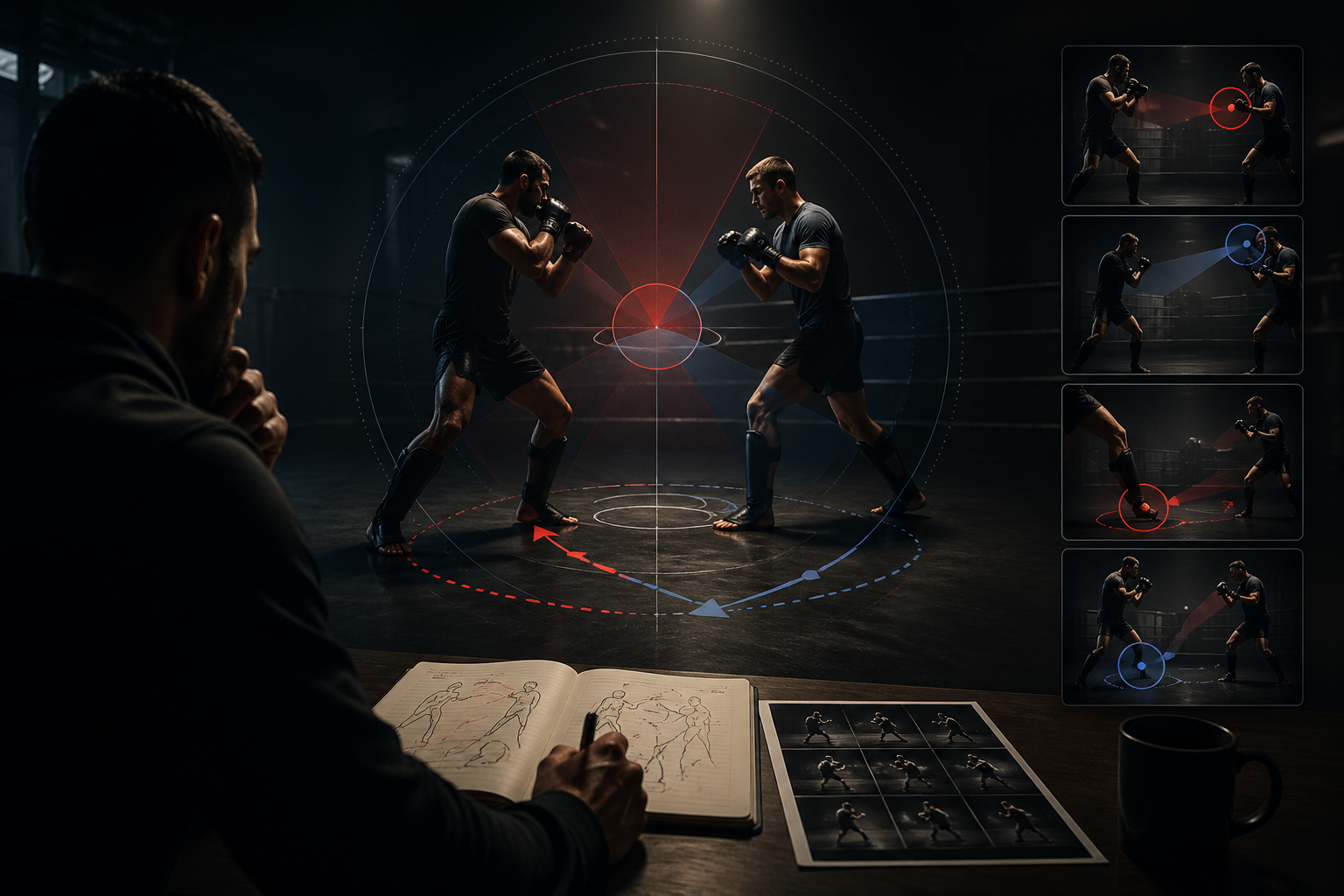
Direct answer: Fighters make bad decisions under pressure because stress narrows attention, speeds up the mind, and makes normal options feel harder to reach. The fix is not “be calmer.” The fix is to notice the first pressure cue, keep structure, and use a small reset before the exchange turns messy.
Fighters usually do not make one dramatic bad choice under pressure. They lose clarity in small steps, then the visible mistake shows up a beat later.
Read this first
- Pressure changes what a fighter notices before it changes what everyone else sees.
- The first mistake is often in breath, posture, or attention, not in technique.
- Good Fight IQ is the ability to keep enough perception online to choose well under stress.
- A smaller reset is usually better than a big correction in the middle of a live round.
What changes under pressure
Pressure does not just make a fighter nervous. It changes the order of operations in the mind. Breathing gets shallow, the eyes lock in, the body starts to rush, and simple choices feel crowded out.
That is why a fighter can still look active while losing access to useful options. They may be moving, striking, or defending, but the decision process has already narrowed.
The real issue is not volume. It is access. Under pressure, the fighter loses clean access to timing, exits, and patient reads.
The visible mistake is usually late. The state change comes first.
- Attention narrows to one threat or one target.
- Breath gets shorter and more shallow.
- Feet square up or stop adjusting.
- The fighter forces action instead of reading space.
- Time feels faster than it really is.
| Pressure shift | What it looks like | Why it matters |
|---|---|---|
| Attention | Eyes stop scanning | The fighter misses exits and secondary options |
| Breath | Rushed or held breath | The body loses rhythm and calm pacing |
| Structure | Feet, posture, or frames collapse | The fighter has less room to solve the exchange |
| Timing | Early, late, or forced responses | The fighter stops matching the beat of the moment |
The hidden decision problem
A fighter rarely thinks, I am choosing badly right now. The problem feels automatic. They chase, shell up, overcommit, freeze, or hurry because the pressure has already changed the decision environment.
That is why this topic belongs in Fight IQ. Fight IQ is not just knowing more moves. It is keeping enough clarity under stress to use the right one at the right time.
When the mind collapses early, the body follows. The mistake on film is often the last step in a much longer chain.
Bad decisions under pressure are often delayed symptoms, not random errors.
- Chasing usually follows a lost sense of control.
- Shelling too early usually follows narrowed attention.
- Freezing usually follows too many competing priorities.
- Overcommitting often follows panic about losing the moment.
- Waiting too long often follows fear of being wrong.
| Decision pattern | Common pressure state | What is usually happening underneath |
|---|---|---|
| Chasing | Status panic | The fighter is trying to win the moment back fast |
| Shelling | Threat overload | The fighter has stopped seeing usable exits |
| Freezing | Too much information | The fighter cannot choose from the menu fast enough |
| Overcommitting | Urgency | The fighter wants one big answer instead of a clean sequence |
What to notice first
Start with the first visible change, not the final mistake. The first cue is usually small: a rushed breath, square feet, locked eyes, a delayed exit, or the urge to force the next exchange.
If you can catch that earlier cue, the correction gets smaller. You are no longer trying to save the whole round. You are trying to recover one readable state.
This is why Spiral Combat keeps returning to state, structure, timing, and perception. Those are the levers that change decisions before the big error lands.
Look for the first narrowing of options, not the loudest error.
- Breathing gets shallow or held.
- The stance stiffens or squares up.
- The eyes stop scanning for new information.
- The fighter forces offense without a clean read.
- The rhythm gets jagged instead of measured.
| Early cue | What it usually means | What to do next |
|---|---|---|
| Rushed breath | Stress is rising | Slow the body with one reset breath |
| Locked eyes | Attention has narrowed | Re-open the scan and look for exits |
| Square feet | Structure is slipping | Rebuild stance and angle before re-entering |
| Forced attack | Urgency has taken over | Pause for one beat and choose a cleaner entry |
A practical way to train it
Use one cue, one reset, and one review question. That is enough to start. The cue tells you pressure is rising. The reset gives the body a usable action. The review question keeps the lesson honest after the round.
Do not make the drill too clever. If the brain has to remember six rules, it will miss the moment that matters. Simpler cues are easier to keep alive under stress.
The goal is not perfect control. The goal is a better chance of recovering clarity fast.
One cue, one reset, one review question is enough to build better pressure reads.
- Cue: notice one early sign of collapse.
- Reset: use one small physical action, like a breath, frame, angle, or exit.
- Review: ask what option disappeared first.
- Repeat the same pattern in film study and live rounds.
- Keep the language short enough to use under stress.
| Part of the loop | Good example | Why it works |
|---|---|---|
| Cue | Eyes stop scanning | It appears before the visible mistake |
| Reset | Small angle exit | It restores usable structure without overthinking |
| Review question | What option disappeared first? | It turns the round into useful data |
Examples you can use right away
Examples matter because pressure looks different in different rooms. A good explanation should still make sense in drilling, sparring, film study, and coaching.
Use the examples below as starting points. Then replace them with your own rounds, clips, or athlete notes. The pattern matters more than the exact action.
When the fighter can name the pattern, the coach can coach the state instead of only the symptom.
Do not just name the bad action. Name the state that produced it.
- If a fighter chases after a miss, status panic may have replaced structure.
- If a fighter shells too early, attention may have narrowed to survival only.
- If a fighter says they felt rushed, the timing problem likely started before the technique failed.
- If a fighter keeps forcing entries, the issue may be urgency, not effort.
- If a fighter stalls after contact, they may have lost the next beat, not the whole exchange.
| Situation | What it often means | Cleaner next move |
|---|---|---|
| Chasing after a miss | Panic about losing the moment | Reset the feet, breathe, and re-enter from structure |
| Shelling too early | Attention narrowed to defense | Name one exit or frame before adding offense |
| Feeling rushed | Perceived time collapsed | Slow the drill and find the first timing cue |
| Forcing entries | Urgency replaced reading | Wait for one cleaner beat and enter with shape |
How this shows up before the obvious mistake
The obvious mistake is late. By the time the fighter is chasing, freezing, or giving up position, the pressure pattern has already been building for a few seconds.
The earlier clues are quieter. The fighter stops scanning. The breath gets tight. The stance gets stiff. The rhythm gets rushed. Then the bad choice appears on film and looks sudden.
A coach who sees the early state can make a much smaller correction. That is usually better than yelling a broad command in the middle of a chaotic exchange.
Fix the state, not just the symptom.
- Look for the first sign of narrowed attention.
- Watch for breath changes before movement errors.
- Check whether the athlete still sees exits.
- Notice when action becomes forced instead of chosen.
- Use one specific coaching sentence, not a speech.
| Before the obvious error | What to look for | Why it matters |
|---|---|---|
| Attention narrows | The fighter stops scanning | The mind has already reduced the menu |
| Breath changes | Short or held breaths | The body is losing rhythm and calm pacing |
| Structure slips | Feet, posture, or frames collapse | The fighter has less usable space |
| Urgency rises | Forced entries or late reactions | The fighter is solving from panic instead of from shape |
A coachable way to think about it
A useful question is not, Do I understand this idea? The useful question is, What will this help me notice sooner?
That question keeps the article tied to action. It gives the coach a language for film review and gives the athlete a way to self-check without turning every round into a theory lesson.
Spiral Combat works best when the idea becomes readable in real time. If it cannot be noticed in a live exchange, it needs a cleaner frame.
The best coaching language is short, specific, and usable under stress.
- Say what changed, not just what went wrong.
- Name the first cue before naming the final mistake.
- Keep the correction small enough to use live.
- Ask what the fighter stopped seeing.
- Tie the lesson to the next rep, not only the last one.
| Coaching line | What it does | Why it helps |
|---|---|---|
| 'Your eyes stopped scanning.' | Names the cue | It points to the first state change |
| 'Rebuild your feet first.' | Restores structure | It gives the athlete one clear task |
| 'What exit did you lose?' | Creates review | It turns the round into usable feedback |
| 'One beat, then go.' | Slows urgency | It protects timing and choice |
A seven-day practice plan
Keep the work small enough to actually do. The point is not to solve the whole mental game in one week. The point is to build a sharper read.
Use one clip, one round, or one session per day. Write down what changed before the visible error. Then test one small reset.
By the end of the week, you should have a personal pressure map: what you do when you rush, what you do when you freeze, and what helps you recover.
Short daily review beats one long, vague reflection.
- Day 1: Watch one round and name the first pressure cue.
- Day 2: Choose one cue that appears before the mistake.
- Day 3: Pick one reset you can use live.
- Day 4: Test the cue and reset in a controlled drill.
- Day 5: Compare one good exchange and one bad exchange.
- Day 6: Write one coaching sentence or self-review note.
- Day 7: Decide what topic needs a deeper study next.
| Day | Action | Result to look for |
|---|---|---|
| 1 | Watch a round and write the first cue | A clearer eye for early pressure signals |
| 2 | Choose one pre-error cue | Less confusion in live work |
| 3 | Pick one reset | A reliable way back to structure |
| 4 | Test in a drill | Proof that the cue can survive motion |
| 5 | Compare two exchanges | A better sense of what changed |
| 6 | Write one lesson | A clean coaching sentence |
| 7 | Review the week | A decision on next training focus |
Common mistakes
Most people do not fail because they lack effort. They fail because the idea stays too broad, too late, or too far from the next rep.
Another mistake is treating composure like personality. In real training, composure is a skill. It is built from repeatable cues, recoverable positions, and honest review.
A third mistake is adding complexity when the athlete needs a cleaner first read. Under pressure, clarity is worth more than theory.
Do not confuse intensity with clarity.
- Trying to fix everything at once.
- Treating toughness as the whole answer.
- Waiting until the obvious mistake shows up.
- Using vague coaching language.
- Turning film review into a lecture instead of a search for cues.
| Mistake | Better fix |
|---|---|
| Trying to fix everything at once | Use one cue, one reset, one review question |
| Confusing intensity with clarity | Ask whether the effort improved options |
| Making the lesson too abstract | Attach it to a real round or clip |
| Skipping the follow-up | Track what to watch next session |
What this is not saying
This is not saying mindset fixes everything. Skill, conditioning, coaching, matchups, and physical reality still matter.
It is also not saying the fighter should become passive or slow. The goal is clearer action, not less action.
A calm read can produce a fast decision because the fighter is no longer trying to solve three imaginary problems at once.
Pressure training should make action clearer, not softer.
- Not a promise that attitude solves every problem.
- Not a call to overthink during live exchanges.
- Not a substitute for technical skill or conditioning.
- Not a claim that every bad decision has one cause.
- Not a reason to ignore fatigue, damage, or matchup dynamics.
| Misread | Better understanding |
|---|---|
| 'Just be calmer' | Clarity under stress is trainable |
| 'Slow means weak' | A clean read can support fast action |
| 'It is only mental' | State, skill, and structure all interact |
| 'One fix solves all' | Different pressure states need different corrections |
Reader checklist
- I can explain the idea in one plain sentence.
- I can point to the first visible signal in a real exchange.
- I know what a better reset looks like.
- I have one cue, one reset, and one review question.
- I can name the state underneath the mistake.
- I know what to watch in the next round or clip.
Next Spiral Combat path
Read the next Fight IQ piece on timing, structure, or decision-making under pressure, then compare it to this article using one round of film or one live session.
Related Spiral Combat reading
FAQ
What is the first sign that pressure is changing a fighter’s decisions?
It is usually a small change before the obvious mistake: breath gets tight, eyes stop scanning, feet square up, or the fighter starts forcing action.
Is this just a mindset problem?
No. Mindset is part of it, but structure, timing, fatigue, coaching, and matchup pressure all shape the decision.
What should a coach say in the moment?
Keep it short and specific. Name the cue, give one reset, and ask for one cleaner choice.
How does this fit with Fight IQ?
Fight IQ is the broader skill of making better choices under stress. This topic explains one part of that skill: keeping perception online when pressure rises.
Where does Spiral Combat fit in?
Spiral Combat treats pressure as something you can read, not just endure. That lens helps connect state, structure, timing, and decision-making.
Key takeaways
- Bad decisions under pressure usually start before the visible error.
- The first cue is often in breath, eyes, feet, or timing.
- A small reset is often better than a big correction.
- Good coaching names the state, not just the symptom.
- Fight IQ grows when fighters learn to recover clarity faster.