Fight Intelligence / Educational Edition
See more of
the fight.
Follow the matchups, understand the exchanges and bring better questions to your next replay. Your event study lives inside Spiral Combat.
Event analysis · Matchup study · Film-study kit
$37 one event
Or $99 USD/month for ongoing access to covered events.
Choose your access →Try the study method firstThe main experience
Your event.
A clearer way to study it.
Open the educational member dashboard for the event you have access to. Use matchup context and structured observation prompts to study the exchanges, then put your own notes to work with the included kit.
- Start with the event. See which published event your access covers before checkout.
- Study the matchup. Put sourced fighter context beside original questions about range, entries, contact and transitions. Missing evidence stays explicit.
- Take the method with you. Your guide, workbook and cue cards support the dashboard experience.
Try it on a completed fight
Holloway vs Gaethje: look beyond the finish.
UFC 300 · April 13, 2024 · Retrospective study example
The result: Max Holloway won by knockout at 4:59 of round five. Check the official result →
The lesson: Knowing who won tells you the outcome. Studying what came before it gives you a better question.
- Pause before the finish. On footage you can legally watch, stop before the final exchange. Record the distance and each athlete’s visible position.
- Follow one change. Advance slowly. Which step, entry or contact changes the distance? Write down what the camera shows before explaining why it happened.
- Check your explanation. Compare an earlier exchange. Does the same detail appear without the same result? Keep a possible explanation separate from a proven cause.
Your takeaway: One timestamp, one visible detail and one question to investigate. That is a useful study note you can repeat with another fight.
What you can do with it
Move from “something happened” to “here’s what I saw.”
- Know where to look. Seven viewing lenses narrow the question: base, range, entry, contact, transition, recovery and adaptation.
- Rewind to the useful moment. Follow what happens before an entry and after an exchange, rather than stopping at the dramatic frame.
- Separate observation from interpretation. Record the timestamp, what is visible, your possible explanation and what remains unknown.
- Make your next replay purposeful. Compare two exchanges, look for an exception and revise your note when the evidence changes.
- Bring a clearer question to your coach. Use a specific clip and a small uncertainty instead of a broad judgement. Coaching is not included.
- Build a manageable study habit. A suggested fourteen-day path gives each short session one job. Reuse the workbook with new footage.
Included with either access option
Read the method.
Record the evidence.
Keep one cue beside you.
See the Exchange
An illustrated 16-page guide to the seven lenses, the three-pass review and common viewing mistakes. Includes a complete hypothetical example and clear limits.
The Round Review Workbook
13 reusable pages for timestamp logs, visible-contact notes, phase maps, comparisons, revisions and a fourteen-day tracker. Print or copy the prompts into your notes app.
Pause / Notice / Check
18 phone-friendly cue cards. Pick a card while watching and get one observation task, one check and a reason to pause.
Each tool comes as a searchable PDF, accessible HTML and plain text: nine files, three distinct tools. No devices, video footage or physical book are supplied.
Seven questions for the replay
Study the exchange.
One detail at a time.
- BaseWhere does the next visible step land?
- RangeWhat route is visible, and what is hidden?
- EntryWhat is the first observable change?
- ContactWhich connection can you point to?
- TransitionWhat visible event changes the phase?
- RecoveryWhat happens after the attempt?
- AdaptationWhat example would make you revise the note?
These are study prompts, not fighter scores or a prediction system.
A complete example from the guide
The second step.
Hypothetical teaching sequence · Not a real bout
- 00:11 Athlete A moves the lead foot forward.
- 00:12 Athlete B moves left in the frame.
- 00:13 A takes a second step.
- 00:14 The athletes make upright contact.
A quick interpretation: “B reads A perfectly and forces a bad entry.”
A more useful note: “A advances; B moves left; A takes a second step before contact. B’s rear foot is briefly obscured.”
See how the workbook improves the note
Possible explanation: B’s lateral movement may have changed A’s approach.
Alternative: A may already have intended two steps.
Unknown: B’s rear foot is briefly hidden.
Next question: Does the second step also appear when B stays in place?
You now have something another viewer can check—and a specific reason to replay the clip.
Look inside the files
A place for what you don’t know.
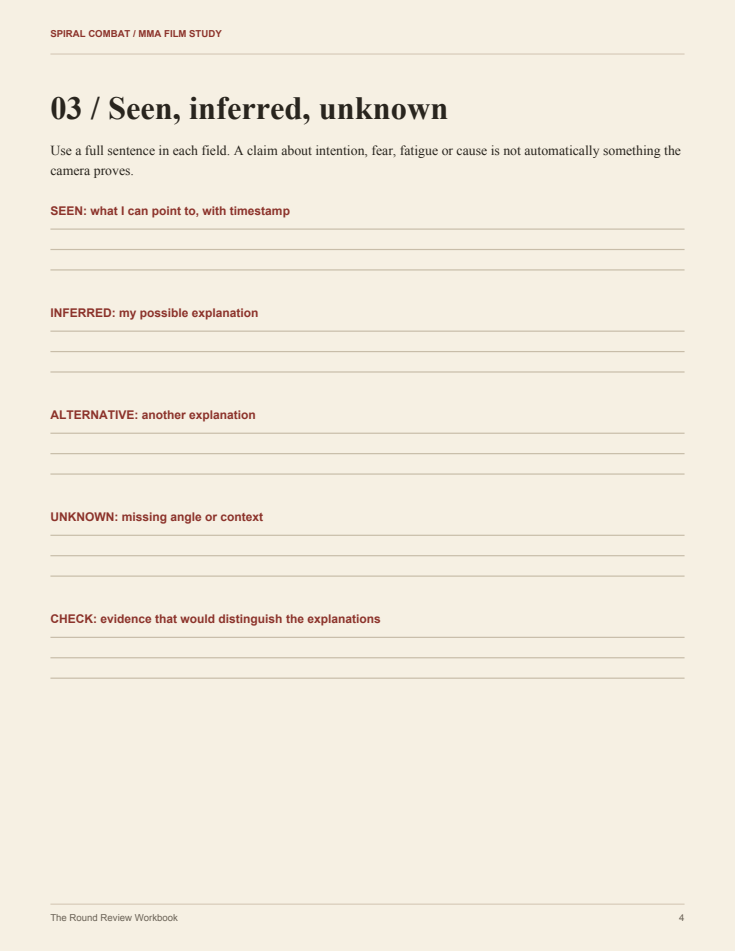
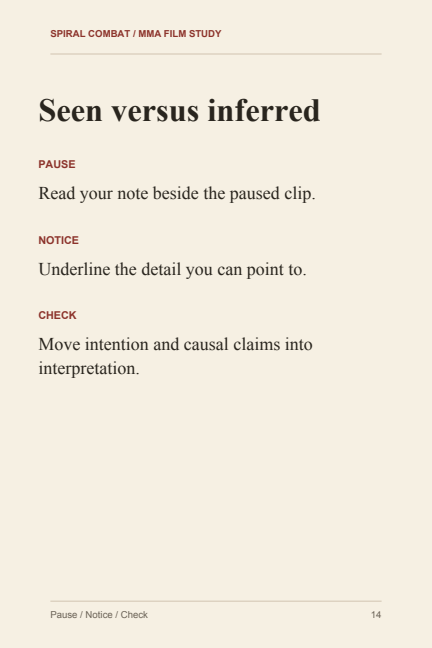
Open either preview to read it at full size. These are excerpts from the buyer files, not mock interface screens.
Start with ten minutes
One short sequence.
Three passes.
- Watch normally. Choose footage you’re entitled to view and establish the broad sequence.
- Pause with one question. Record three timestamps: before, change and after.
- Check the story. Replay at normal speed. Add an alternative explanation and a visibility limit.
The fourteen-day plan helps you repeat the method. It is a suggested study schedule, not a promise of improvement within a deadline.

Built for deliberate viewing
For curious fans,
students and coaches.
Use it to organise film study, make your notes more precise and prepare a better conversation. No physical drills are required.
This edition is for learning about MMA. It includes no footage, personal coaching or judging qualification. The dashboard focuses on factual event context, observation and your own study notes.
Where the method comes from
Spiral concepts.
Clear boundaries.
Adapted from The MMA Codex’s phase-based study sequence and The Silat Codex’s work on preparation, support, movement and return routes. The viewing method, worked examples and worksheets were written specifically for this kit with AI assistance.
These are editorial learning tools, not a validated performance model. The guide identifies its source concepts and limits. Use the source links to check the factual context and the prompts to form your own questions.
Before you choose
Clear access.
No surprises.
What does $37 cover?
One specific published event, named before checkout, plus the complete film-study kit. It is a one-time purchase, not a subscription or access to future events.
What does $99/month cover?
Ongoing access to the educational Fight Intelligence dashboard for covered, published events while your subscription is active. The study kit is included while active. $99 USD is charged each month until cancellation; taxes, if applicable, are shown at checkout.
Do I need to buy the $37 option as well?
No. Choose one access option. The monthly option replaces the single-event purchase in this offer.
Does this include every UFC event?
Access covers the events Spiral Combat publishes in this educational product. We do not promise every event or a particular report schedule. Check the named available event before buying.
What is included in the film-study kit?
The 16-page See the Exchange guide, 13-page Round Review Workbook and 18 Pause / Notice / Check cue cards. Each comes as PDF, accessible HTML and plain text.
Do I receive fight footage?
No. Use footage you are entitled to watch. Spiral Combat is independent and is not affiliated with UFC or a broadcaster.
How do I open my purchase?
Sign in to the member platform using your checkout email. Your educational event access and included study materials appear after verified payment. Open the educational dashboard →
I already own Spiral products. Should I buy again?
Check your member access first. Existing purchases remain separate. Active All-Access already includes the study kit; this does not by itself establish access to the new educational event dashboard.